


The Science Behind Diamond Sparkle and Light Reflection
Introduction
The brilliance and sparkle of Diamonds have captivated people for centuries. Diamonds command attention, no matter where they go, whether that's in engagement rings or luxury necklaces or elegant earrings, they capture the eye with their interaction with light. Many people think that beauty in a diamond is determined by its size or its price, but the true secret is the science behind the light reflection, precision edge, precision cutting and optical performance.
Nowadays, the jewellery market is more conscious about the quality and artisanal skills of diamonds. They wish to know why the diamonds are more brilliant and radiant in some than in others. Brilliant, beautiful and ethical diamond choices are often the priorities of jewelry experts and contemporary brands like ErayaSparkle since customers appreciate a blend of beauty and knowledge. When buying a sparkle, it's helpful to know the science of sparkle, and it's even more beneficial to understand the craftsmanship that goes into every beautiful piece of sparkle.
The art of reflecting light on diamonds is beautiful
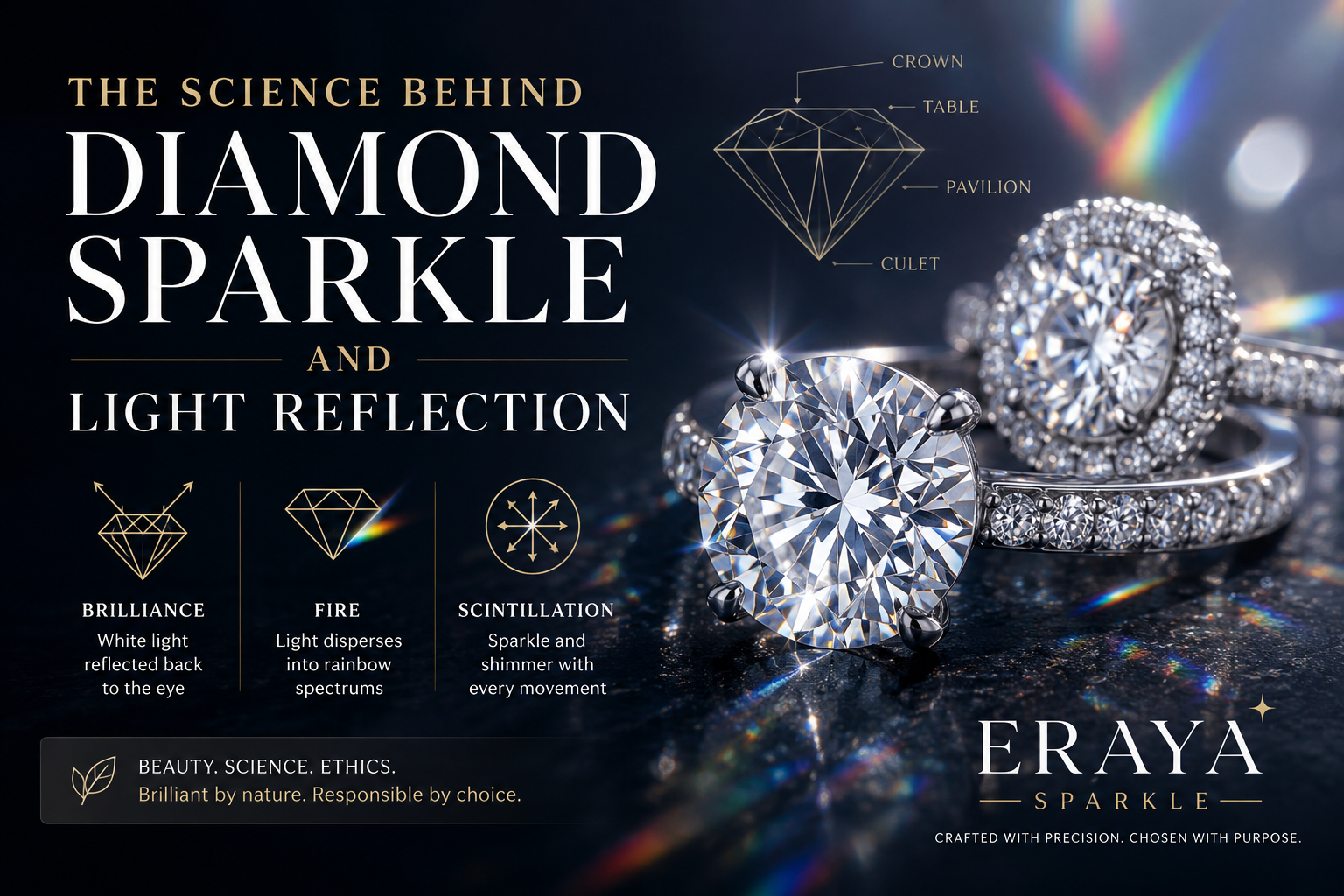
The sparkle of a diamond starts when light enters the diamond. Diamonds are much more highly refractive than common gemstones, meaning its refractive ability is able to bend and reflect light more effectively. If the light enters a properly cut diamond, it is shined through the internal facets, and reflected back toward the viewer rather than out the base of the diamond.
This scientific phenomenon gives rise to the bright white shine referred to as brilliance. Meanwhile, light splits to rainbow colors, creating what they call fire. When the diamond is in motion under the light, it sparks and scatters lights, which is called as scintillation. The combination of these three effects renders diamonds visually outstanding and unlike other gem stones employed in exquisite jewellery.
Why is it that Diamond Cut is more important than Diamond Size?

While many people put a lot of emphasis on the carat weight of a diamond, the cut of a diamond is frequently the most important factor in determining how bright it shines, in the eyes of gemologists. A diamond, even with a big size, can look plain if it's poorly cut. A well-cut diamond reflects light inwards as much as possible, a badly cut diamond lets light escape from the sides or bottom.
The angles and symmetry of a diamond are an important factor in its beauty. Precision cut facets are small mirrors that reflect light back into the eye. That is why it is very common to find that smaller diamonds with good cuts are brighter than larger stones with less good cuts. Round brilliant diamonds are particularly popular due to their facet configuration that is designed for optimum sparkle and fire.
Today's buyers are often thorough in comparing settings and diamond cuts before making a purchase for a really elegant engagement ring. Some jewelry lovers like halo rings for women because the other diamonds around it add to the brilliance and thus make it seem larger and more sparkling than what it is.
The Unseen Use of Diamond Shapes
The flat, shiny faces that are cut onto a diamond. Each facet is precisely placed for optimal light performance and overall brilliance. Typically, a traditional round brilliant diamond will have 57 or 58 facets that are all shaped to maximize sparkle.
Different parts of the gemstone reflect light in different ways.The light reflected from the crown, pavilion, table, and culet will be different. These sections, if sized appropriately, will keep light inside the stone for a longer period of time before it exits through the top. This gives diamonds a bright, lively look characteristic of high quality diamonds. If the facets are misaligned, it can diminish sparkle and cause a dark or lifeless appearance.
Experts in jewelry design recognize that there is a direct link between the precision of facets and beauty. That's one of the reasons those high-quality jewelry collections emphasize craftmanship more than just the carat size. During the last few years, a lot of eco-friendly jewelry firms began to employ cutting edge technology to ensure better light performance within the natural and lab-grown gemstones.
Understanding Diamond Fire and Rainbow Sparkle

Fire, one of the most beautiful visuals of a diamond, is one of the reasons it is so sought after. This occurs when the white light refracts through the diamond into its spectrum. Red/blue/yellow/green/and orange flashes flash depending on movement and lighting.
The greater the amount of dispersion, or slowing down of light, the greater the amount of bright, intense flashes of colour that are produced by diamonds, as they slow down light more than many gemstones. In direct lighting (sunlight, spotlights, candlelight) fire is more noticeable. Brilliance and fire are perfectly balanced in well-cut diamonds, lending a luxurious look seen from every angle.
This equilibrium is especially significant when it comes to contemporary wedding ring patterns. Today's buyers are more interested in elegant designs that are both brilliant and simple. With careful selection, a lab grown solitaire ring can emit superb fire and sparkle with a modern and sustainable aspect to it that pays attention to the buyer's aesthetic and moral preferences.
How Clarity and Colour Influence Sparkle
Although the most critical factor is the cut, the clarity and color play a part in determining the brilliance of a diamond. Internal inclusions or external blemishes in the stone are called clarity. If there are large inclusions they can disrupt light flow, slightly reducing sparkle. But, if a diamond has an inclusion that is small, it is still eye-catching.
Color also plays a role in the visual brightness of the diamond. Near-colorless diamonds reflect light better since the yellow hues absorb light more. For maximum brilliance, color grades from D to G are more popular. However, these experts typically advise to cut first and color second as an outstanding cut can make the lower color look better.
Jewelry professionals are often trained to teach their clients how to balance all four of the diamond quality factors, rather than concentrating on one. Brands such as erayaSparkle often emphasise craftsmanship and optical beauty since today's consumers are looking for more than just looks.
Why Lab Grown Diamonds Shine the Same Way
There are still many that wonder if it is possible to create a sparkle that is different from a mined diamond. From a scientific standpoint, lab grown diamonds have the same optical, physical, and chemical characteristics as natural diamonds. They are real diamonds made by using high technology processes and they reflect, refract and disperse light in the same way.
This is why lab diamonds are gaining in popularity in today's jewelry business. The beauty, sustainability and affordability is what consumers want. Young buyers are particularly fond of ethical luxury items that provide good brightness and no environmental issues associated with conventional mining.


 English
 Arabic
 Français
 Español
 Deutsch
 Türkçe
 Dutch
Dutch
 Italiano
 Russian
 Romaian
 Portuguese (Brazil)
 Greek
Greek