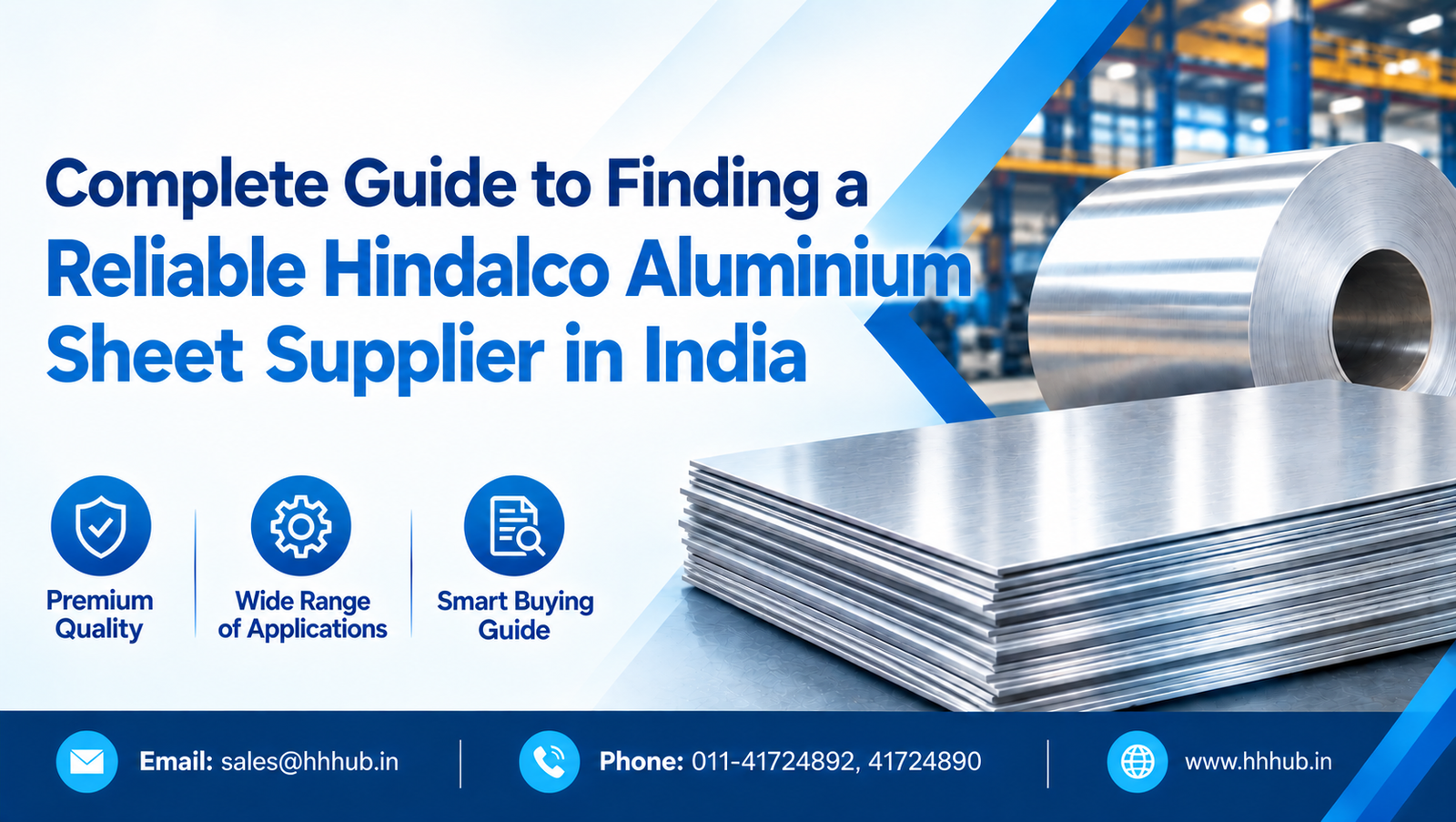
Complete Guide to Finding a Reliable Hindalco Aluminium Sheet Supplier in India - Lucknow
Aluminium sheets play a quiet but essential role in modern manufacturing. From vehicle panels to false ceilings to electrical enclosures, this material shows up in far more products than most buyers realise. Among the brands available in the Indian market, Hindalco aluminium sheets are widely recognised for their consistent quality and broad range of alloy grades. For businesses in Delhi and across India, choosing the right Hindalco Aluminium Sheet Supplier is just as important as choosing the right grade or thickness. A dependable supplier affects everything from lead times to the accuracy of the sizes you receive. HHhub, a Delhi-based supplier of Hindalco aluminium sheets, works with industrial, commercial and fabrication customers who need consistent stock and practical support when placing orders. This guide walks through what Hindalco aluminium sheets are, where they’re used, how to choose a grade, and what to look for when selecting a supplier. What Are Hindalco Aluminium Sheets? Aluminium sheets are flat-rolled aluminium products, produced in a range of thicknesses and widths, and used wherever a lightweight but structurally useful metal is needed. Hindalco Industries, one of India’s major aluminium producers, manufactures these sheets for use across construction, automotive, electrical, packaging and general industrial fabrication. What makes aluminium sheets useful across such different industries comes down to a small set of core properties: low weight relative to strength, natural resistance to corrosion, and good conductivity of both heat and electricity. Depending on the alloy and finish selected, the same basic product can be adapted for structural panels, decorative cladding, or components inside electrical equipment. It’s worth noting that exact performance figures, certifications and technical specifications can vary by alloy, thickness and batch. Buyers with strict technical requirements should always confirm current specifications directly with their supplier before finalising an order, rather than relying on general industry claims. Key Benefits of Hindalco Aluminium Sheets Lightweight construction. Aluminium is significantly lighter than steel for a comparable sheet size, which reduces transport costs and eases handling during fabrication — a meaningful advantage in industries like automotive manufacturing where every kilogram affects fuel efficiency. Corrosion resistance. Aluminium naturally forms a thin oxide layer on its surface, which helps protect the metal underneath from rust and environmental degradation. This makes it a practical choice for outdoor structures, roofing and coastal or humid environments. Durability. Despite being lightweight, aluminium sheets hold up well under mechanical stress and repeated handling, which is why they remain a preferred material for long-service components. Thermal conductivity. Aluminium transfers heat efficiently, making it useful in heat exchangers, cooking equipment and other applications where heat needs to move quickly across a surface. Electrical conductivity. Good conductivity means aluminium sheets are also used in electrical panels, bus bars and related equipment where current needs to flow with minimal resistance. Fabrication suitability. Aluminium sheets can be cut, bent, welded and formed using standard fabrication processes, which keeps production timelines manageable for manufacturers. Surface finish options. Depending on the intended use, sheets can be supplied with a mill finish, polished finish, or other surface treatments, giving buyers flexibility between purely functional and more visually finished applications. Common Applications of Aluminium Sheets Automotive Industry Aluminium sheets are used in body panels, truck trailer bodies, fuel tanks and various vehicle components. Reducing the weight of these parts contributes directly to better fuel efficiency and handling, which is why automotive manufacturers continue to shift certain components from steel to aluminium. Construction Industry In construction, aluminium sheets appear in roofing, wall cladding, false ceilings and architectural detailing. Their resistance to weathering makes them suitable for both exterior and interior applications, and their light weight simplifies installation on large structures. Electrical Industry Because aluminium conducts electricity well and is far lighter than copper, it’s commonly used in electrical panels, bus bars and other conductive components where weight and cost are both considerations. Packaging Industry Aluminium sheets and foils are widely used in food packaging, pharmaceutical packaging and general product packaging, largely due to their barrier properties and ease of forming into different shapes. Industrial Equipment Manufacturers of machinery parts, heat exchangers and chemical processing equipment often rely on aluminium sheets for components that need to be both lightweight and resistant to corrosion in demanding environments. Understanding Aluminium Sheet Grades Not all aluminium sheets are the same. Different alloy grades are formulated to balance strength, corrosion resistance, conductivity and formability differently, and the “right” grade depends entirely on what the sheet will be used for. Commonly available grades include: 1100 and 1050 — known for high corrosion resistance and strong thermal conductivity, often used where formability matters more than strength. 3003 — a general-purpose alloy valued for its balance of strength, corrosion resistance and workability, commonly seen in fabrication and construction. 5052 and 5083 — offer higher strength and good performance in marine or structural environments where durability under stress is important. 6061 — a versatile structural alloy often chosen for applications requiring higher strength alongside reasonable formability. 8011 — frequently used in packaging and foil-related applications. No single alloy is universally “best.” The right choice depends on factors like required strength, exposure conditions, conductivity needs and how the sheet will be fabricated. Buyers unsure which grade fits their application should discuss the intended use with their supplier before ordering, rather than choosing based on price or availability alone. Aluminium Sheet Thickness, Size and Finish Getting the dimensions right matters as much as choosing the correct alloy. A sheet that’s too thin may not hold up structurally, while one that’s thicker than necessary adds unnecessary material cost and weight. Buyers should think through: Thickness — required for the load, wear or conductivity the application demands Width and length — to minimise offcuts and match fabrication equipment Surface finish — mill finish for purely functional uses, or polished/coated finishes where appearance matters Standard versus customized dimensions — standard sizes are typically faster to source, while custom sizes suit specific project requirements As a reference point, Hindalco aluminium sheets available through HHhub are typically stocked in thicknesses






 English
 Arabic
 Français
 Español
 Português
 Deutsch
 Türkçe
 Dutch
Dutch
 Italiano
 Russian
 Romaian
 Greek
Greek