


High Alumina Fire Bricks for Kilns, Furnaces, and Boilers | Ready Stock
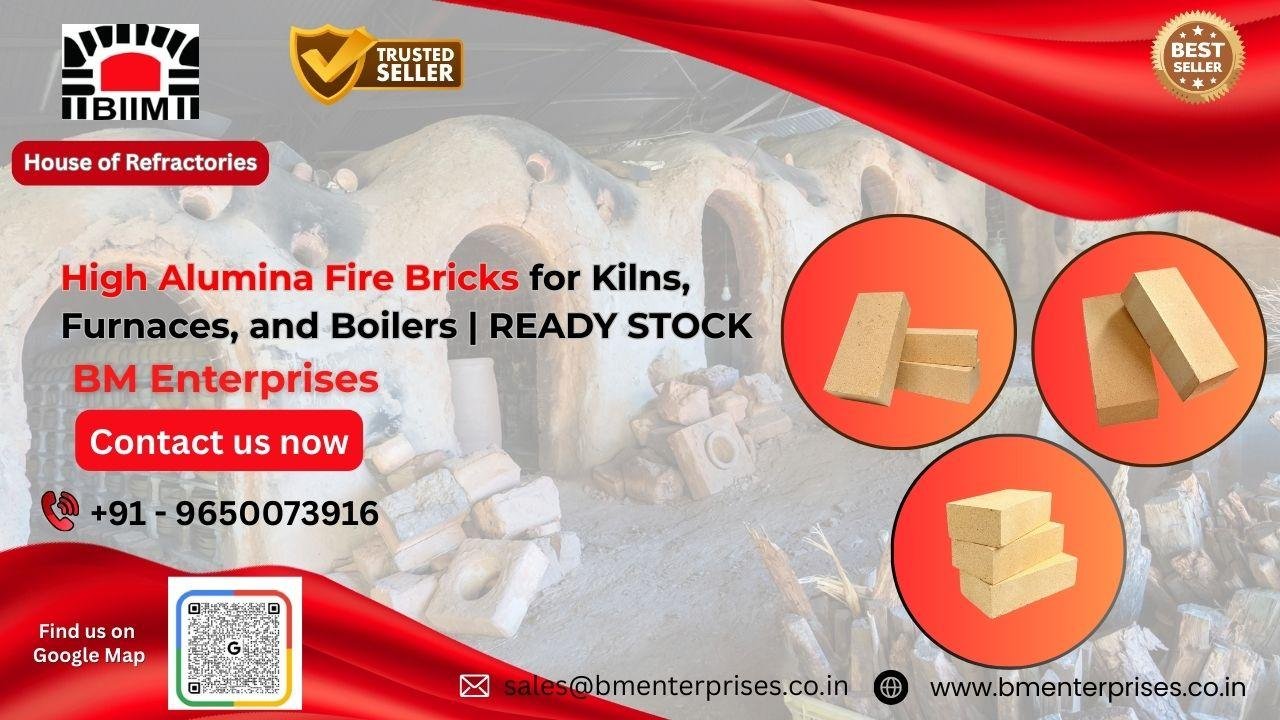
High-temperature industrial processes require refractory materials that can withstand high pressure and intense chemical environments, even at elevated temperatures. This is exactly where high alumina fire bricks prove critical. Being widely used in kilns, furnaces, and boilers as refractory bricks, these bricks have been designed to provide strength and stability. BM Enterprises, a well-known distributor of refractory bricks in India, has designed high-alumina refractory bricks catering to the growing demands of various industries.
High alumina fire bricks are made using alumina-containing raw materials such as calcined bauxite and refined clay. The alumina (Al₂O₃) content is always between 45% and over 70%, and this is an important factor in deciding the thermal and mechanical properties of fire bricks. In layman's terms, the greater the alumina content in fire bricks, the greater is the ability of the bricks to withstand heat, slags, and load deflection. For such industries where the temperature is high, this difference is not small – it is mission-critical.
Understanding High Alumina Refractory Bricks
While conventional fire clay bricks are meant for service under standard conditions, high alumina bricks are designed to stand and function under severe environments. Consequently, their microstructure is dense and well-bonded, which enhances the mechanical load-bearing capacity and resistance against wear. Carefully selected raw materials in production go through crushing, grading, mixing, and high-pressure pressing before firing at carefully controlled temperatures. This ensures uniform grain distribution and consistent performance in every brick supplied by BM Enterprises.
Refractory performance is normally associated with quality control. Each batch of high alumina fire bricks is tested for chemical composition, bulk density, apparent porosity, cold crushing strength, and refractoriness under load. All these parameters are indicative of a brick that can bear continuous exposure to high temperature without cracking, spalling, or structural failure.
Why Alumina Content Matters in High-Temperature Applications
The presence of alumina gives strength to refractory materials. With the increase in the value of alumina content, the refractoriness of the brick becomes stronger; hence, the brick works effectively in a range of temperatures between 1400°C and 1800°C. The brick has good resistance in the case of acids and alkalies in the form of slag; this is especially true in the case of cement kilns, steel furnaces, and power plant boilers.
Another very important benefit is resistance to thermal shock. This is because industrial furnaces and kilns work under conditions of very fast heating and cooling cycles. Poor-quality materials would readily crack due to this, but the better alumina fire bricks have better resistance to thermal shock.
High Alumina Fire Bricks Supplied by BM Enterprises
The range of high alumina bricks supplied by BM Enterprises meets the needs of different industries. Bricks containing about 50% alumina find extensive applications in temperature zones that are moderately high, where cost efficiency is a priority. Where performance conditions become more severe, 60% alumina bricks provide an excellent blend of performance and durability. In extreme heat zones such as the kiln burning area and hearth of furnaces, bricks with 70% or higher alumina content exhibit better refractoriness and mechanical strength.
The typical physical properties for these bricks include high bulk density, controlled porosity, and strong cold crushing strength-all directed at ensuring stability under mechanical and thermal stress. Refractoriness under load is of particular importance in vertical structures that must support great weights at high temperatures without deforming.



 English
 Arabic
 French
 Spanish
 Portuguese
 Deutsch
 Dutch
Dutch
 Italiano
 Russian
 Romaian
 Portuguese (Brazil)
 Greek
Greek