


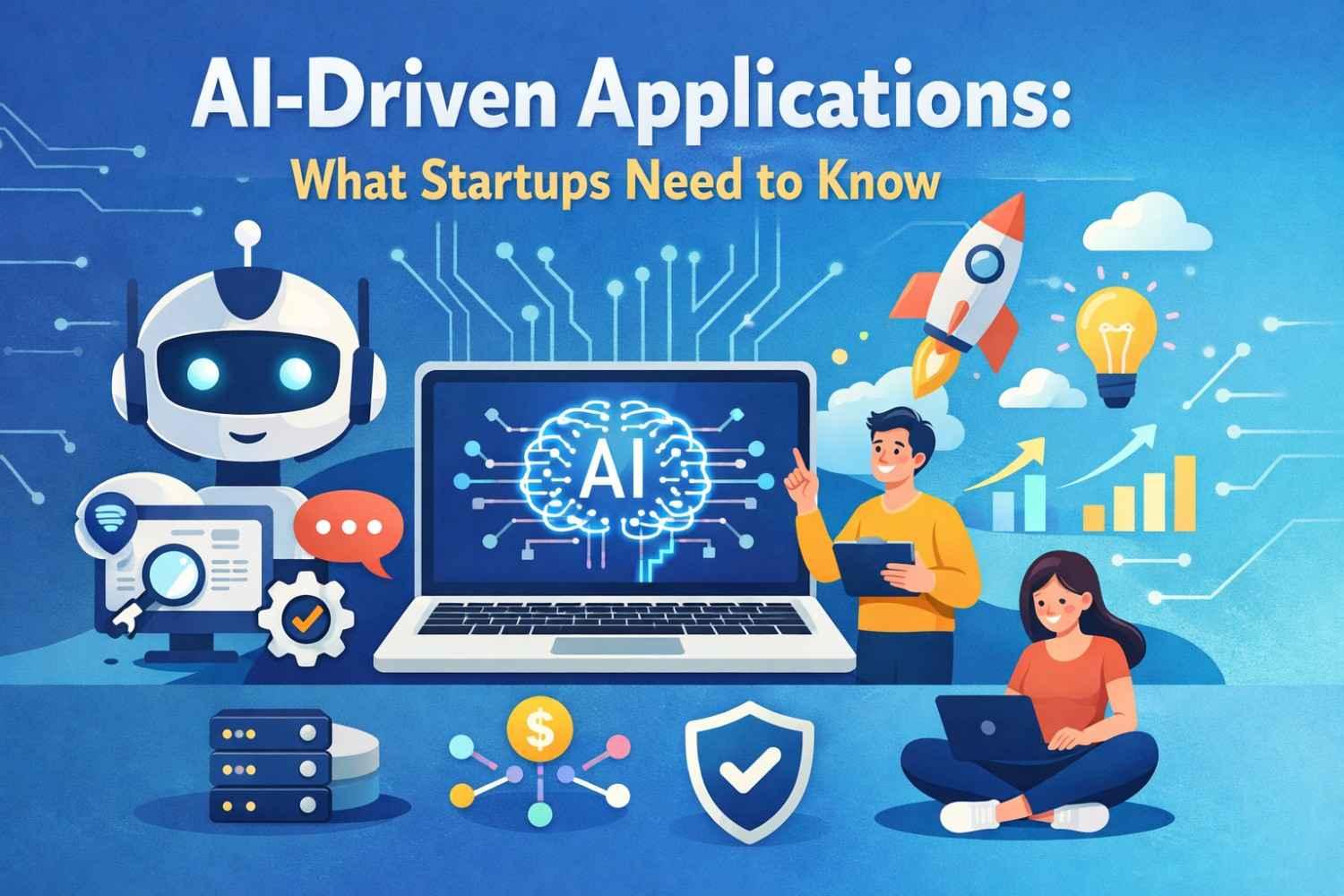
AI has become the two most powerful letters in startup culture. Slide decks sparkle with it, investor meetings orbit around it, and product roadmaps stretch awkwardly to accommodate it. Yet beneath the buzz lies a quieter reality: most startups don’t fail at AI because the technology is weak—they fail because expectations are wrong. This article cuts through the hype to examine what AI-driven applications actually demand from startups. Along the way, it explores trade-offs, missteps, and hard-earned lessons that rarely make it into keynote talks (or glossy Medium posts).
What AI-Driven Actually Means (and What It Doesn’t)
AI-driven is often used as shorthand for “technically impressive,” but the term deserves more precision. An AI-driven product relies on machine learning or intelligent systems as a core value driver, not a decorative add-on. Autocomplete suggestions and smart filters are useful, but they don’t necessarily define the product. Confusion here leads to overengineering and misaligned priorities. Startups benefit from asking a blunt question early: if the AI were removed, would the product still work? If the answer is yes, AI may not be the engine—just the paint job.
Why Startups Are Rushing Into AI Sometimes for the Wrong Reasons
The rush toward AI isn’t purely technological; it’s emotional. Fear of missing out, investor signaling, and competitive anxiety push founders to adopt AI before the problem is fully understood. Market narratives reward bold claims, not quiet restraint. Unfortunately, this pressure often leads to premature complexity. Teams chase AI credibility instead of user value, mistaking attention for traction. The result is a fragile product built to impress rather than endure. Momentum matters, but direction matters more—and AI rarely fixes a shaky foundation.
The Startup Reality Check: Costs, Complexity, and Constraints
AI adds weight to every part of a product lifecycle. Infrastructure costs rise, development timelines stretch, and hiring becomes more specialized. Models require tuning, monitoring, and regular updates, none of which are one-time tasks. Unlike traditional features, AI systems degrade if ignored. For early-stage startups, these demands can quietly drain focus and capital. What looks elegant in a demo can become unwieldy in production. The real challenge isn’t building AI—it’s sustaining it without losing momentum elsewhere.
Choosing the Right AI Use Case (Before Writing a Single Line of Code)
The strongest AI-driven applications solve narrow, repeatable problems with measurable impact. Fraud detection, personalization, and prediction often succeed because they align well with data availability and clear outcomes. Weak use cases tend to be vague, experimental, or disconnected from user pain. A helpful filter is value density: does AI significantly improve speed, accuracy, or scale? When the answer is unclear, restraint is often the smarter move. Good AI feels inevitable in hindsight, not forced in execution.
AI and Product Architecture Decisions
AI reshapes architectural choices in subtle but lasting ways. Decisions about APIs, model hosting, and data pipelines affect scalability from day one. In Web App Solution, latency, observability, and integration complexity become central concerns. A modular approach often reduces risk, allowing AI components to evolve independently. Overly tight coupling, on the other hand, makes iteration painful. The best architectures treat AI as a service with boundaries, not as an omnipresent layer woven indiscriminately through the codebase.
AI in Mobile Products: Special Considerations
AI behaves differently on mobile platforms, where performance and user patience are limited. On-device processing improves privacy and speed but restricts model size and flexibility. Cloud-based inference offers power at the cost of latency and connectivity dependence. In Mobile Application Development, these trade-offs directly affect user experience. Battery drain, unpredictable responses, and opaque behavior erode trust quickly. Successful mobile AI is invisible when it works and forgiving when it fails—a higher bar than most teams initially expect.
Data: The Asset Startups Underestimate the Most
Models don’t learn from ambition; they learn from data. Startups often discover too late that their datasets are incomplete, biased, or simply irrelevant. Early data is messy, inconsistent, and expensive to clean. This isn’t a flaw—it’s the norm. The mistake lies in assuming algorithms will compensate for weak inputs. In practice, better data usually beats better models. Teams that invest early in data quality, governance, and feedback loops gain a compounding advantage that competitors struggle to match.
Ethics, Privacy, and Regulatory Landmines
AI introduces risks that extend beyond performance metrics. Bias, explainability, and data privacy now shape user trust and legal exposure. Regulations vary by region, but enforcement is tightening everywhere. Ignoring these factors doesn’t eliminate responsibility—it delays the reckoning. Ethical design isn’t about avoiding innovation; it’s about sustaining it. Startups that treat compliance as an afterthought often discover that retrofitting trust is far more expensive than building it intentionally from the start.
Measuring ROI on AI (Without Fooling Yourself)
AI success isn’t measured by technical sophistication but by outcomes. Improved retention, reduced costs, or faster decision-making matter more than model accuracy alone. Vanity metrics create a comforting illusion of progress while masking stagnation. Effective teams define success criteria before deployment, not after. When AI fails to move the needle, the correct response isn’t endless tuning—it’s reassessment. Killing an underperforming feature can be a sign of discipline, not defeat.
Common Startup Mistakes with AI-Driven Applications
Patterns repeat across industries. Teams overbuild before validating demand, underestimate maintenance, and neglect user experience in favor of cleverness. Another frequent misstep involves timing—either hiring specialists too late or too early. AI magnifies existing problems rather than solving them. When communication breaks down between product, data, and engineering, complexity multiplies. Learning from these mistakes doesn’t require failure firsthand; it requires honesty about what AI can and cannot realistically deliver.
The Future Outlook: What Founders Should Prepare For Now
As models become commoditized, differentiation will shift elsewhere. Proprietary data, thoughtful UX, and domain expertise will matter more than raw algorithms. The future favors startups that integrate AI quietly and effectively rather than loudly and everywhere. Strategic patience will outperform reactive adoption. AI will remain powerful, but no longer novel. Founders who prepare for this normalization—by focusing on fundamentals—will be better positioned when the hype inevitably fades.
Conclusion
AI isn’t a shortcut to success—it’s a multiplier. When paired with a strong product, clear thinking, and reliable data, it can unlock remarkable value. When layered onto confusion, it simply accelerates failure. The startups that win won’t be the loudest about AI; they’ll be the most deliberate. Progress favors those willing to slow down, ask better questions, and build intelligence where it truly belongs.
FAQs
What is an AI-driven application?
An AI-driven application uses machine learning or intelligent systems as a core component of its value, not just as a supporting feature.
Do startups need AI from day one?
Not always. Many successful products add AI later, once user behavior and data patterns are better understood.
How expensive is AI to implement?
Costs vary widely, but data preparation, infrastructure, and ongoing maintenance are often underestimated.
Is AI better for web or mobile apps?
Both can benefit, but mobile introduces stricter constraints around performance, privacy, and usability.
What is the biggest AI mistake startups make?
Building AI before clearly defining the problem it is meant to solve.



 English
 Arabic
 Spanish
 Portuguese
 Deutsch
 Turkish
 Dutch
Dutch
 Italiano
 Russian
 Romaian
 Portuguese (Brazil)
 Greek
Greek