


Product & SaaS Development: Building Scalable Digital Solutions for Modern Businesses
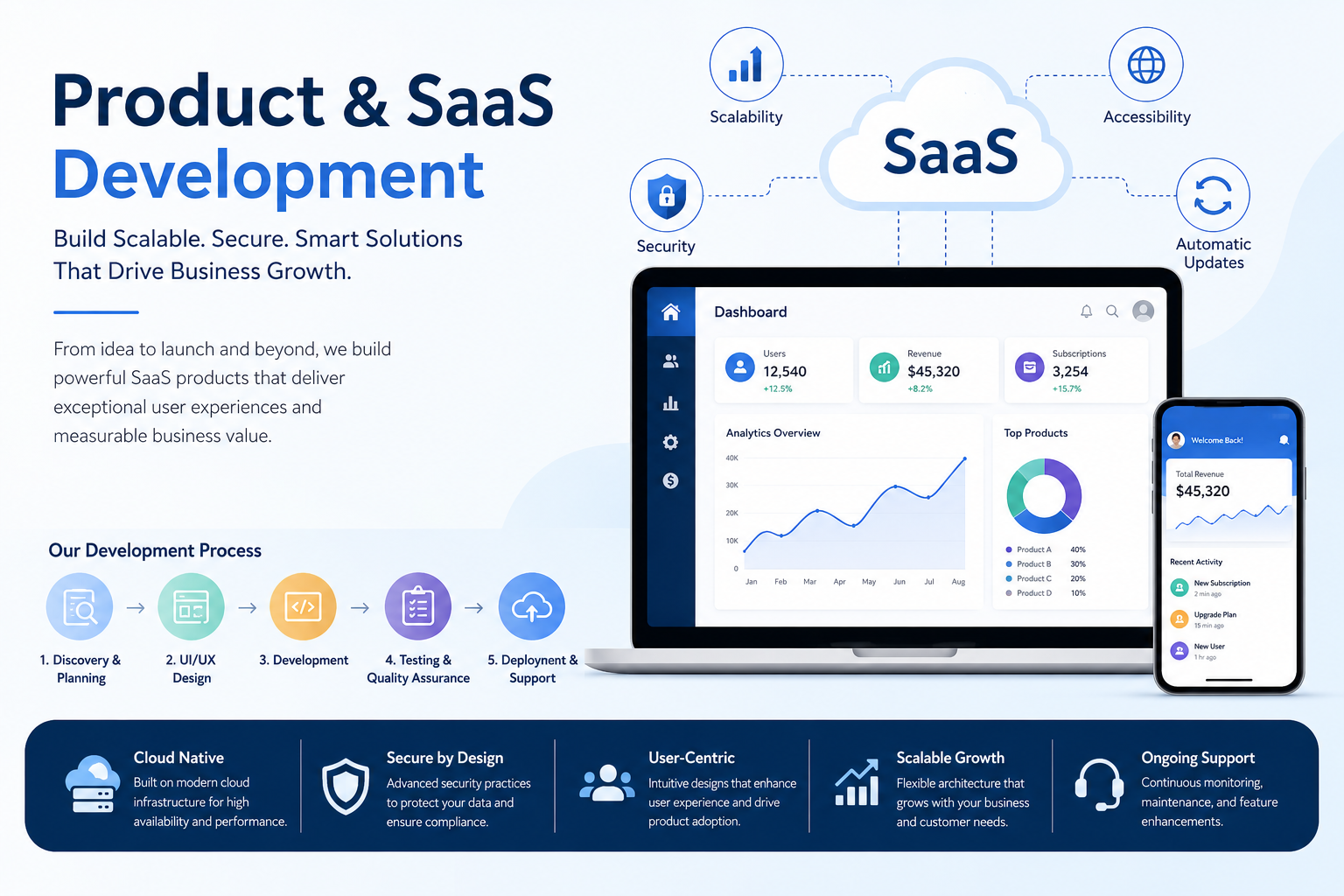
The digital transformation of businesses has accelerated rapidly in recent years, making software products an essential part of business growth and customer engagement. Whether it's a startup launching an innovative application or an enterprise modernizing its digital ecosystem, Product and Software as a Service (SaaS) development plays a crucial role in delivering scalable, secure, and user-friendly solutions.
Product & SaaS development is more than writing code. It involves understanding customer needs, designing intuitive user experiences, building reliable software architecture, and continuously improving the product based on user feedback. With cloud technologies becoming the standard, SaaS applications provide businesses with flexible, cost-effective, and scalable solutions that can be accessed from anywhere.
What is Product & SaaS Development?
Product development is the process of transforming an idea into a functional digital solution. It covers every stage of the software lifecycle, from initial planning and market research to design, development, testing, deployment, and ongoing maintenance.
Software as a Service (SaaS) refers to cloud-based applications that users access through a web browser or mobile application instead of installing software on individual devices. These applications are typically offered through subscription-based pricing models, allowing businesses to generate recurring revenue while providing customers with continuous access to the latest features and updates.
Today, SaaS solutions are widely used across industries because they simplify software management, reduce infrastructure costs, and enable businesses to scale efficiently.
Benefits of Product & SaaS Development
Modern SaaS applications offer numerous advantages for both businesses and end users.
Scalability
One of the biggest benefits of SaaS products is their ability to scale as business needs evolve. Whether serving hundreds or millions of users, cloud-based infrastructure allows applications to expand without major system redesigns.
Cost Efficiency
Traditional software often requires expensive hardware, maintenance, and manual upgrades. SaaS applications eliminate many of these costs by leveraging cloud infrastructure, reducing operational expenses for both providers and customers.
Accessibility
Cloud-based software enables users to access applications anytime and from virtually any location using an internet connection. This flexibility supports remote work, global collaboration, and improved customer experiences.
Automatic Updates
SaaS platforms allow developers to release new features, security patches, and performance improvements without requiring users to manually install updates. This ensures customers always use the latest version of the software.
Enhanced Security
Modern SaaS applications incorporate advanced security measures such as data encryption, secure authentication, regular backups, and continuous monitoring to protect sensitive information and maintain compliance with industry standards.
The Product Development Process
Successful software products follow a structured development process that reduces risks while ensuring quality and reliability.
Product Discovery
Every project begins with understanding business objectives, market opportunities, and customer challenges. Research and requirement gathering help define product goals, identify target audiences, and prioritize features that deliver the greatest value.
UI/UX Design
User experience significantly impacts product adoption. Designers create wireframes, prototypes, and interactive interfaces that make software intuitive, visually appealing, and easy to navigate across different devices.
An effective user interface not only enhances customer satisfaction but also improves user retention and engagement.
Software Architecture
Building a strong technical foundation is essential for long-term scalability. Software architects design systems that support performance, security, and future expansion while ensuring efficient communication between various application components.
Modern architectures often utilize cloud services, APIs, microservices, and containerized deployments to improve flexibility and maintainability.
Development
Using Agile methodologies, developers build software incrementally through short development cycles. This approach enables continuous feedback, faster feature delivery, and the flexibility to adapt to changing business requirements throughout the project.
Quality Assurance
Testing is an essential part of software development. Comprehensive quality assurance includes functional testing, integration testing, performance testing, usability testing, and security assessments to ensure the application performs reliably under real-world conditions.
Early identification of issues reduces development costs and improves overall product quality.
Deployment and Maintenance
After successful testing, the application is deployed to production environments where users can begin utilizing its features. Ongoing maintenance includes monitoring system performance, fixing bugs, releasing new features, and optimizing the application based on user feedback and evolving business needs.


 Arabic
 Français
 Español
 Português
 Deutsch
 Türkçe
 Dutch
Dutch
 Italiano
 Russian
 Romaian
 Portuguese (Brazil)
 Greek
Greek