


How Customized Direct Mail Helps Businesses Build Stronger Customer Relationships
Most businesses do not struggle because customers dislike them. They struggle because customers forget them.
A homeowner may appreciate a contractor’s work and still lose the company’s phone number six months later. A restaurant customer may enjoy dinner but never think about the restaurant when planning the next family gathering. Even loyal customers become distracted when competitors, emails, social ads, and everyday responsibilities compete for their attention.
We have seen this problem across many direct mail campaigns. Businesses often focus so heavily on finding new customers that they overlook the people who already know the brand. That leaves a valuable opportunity sitting untouched.
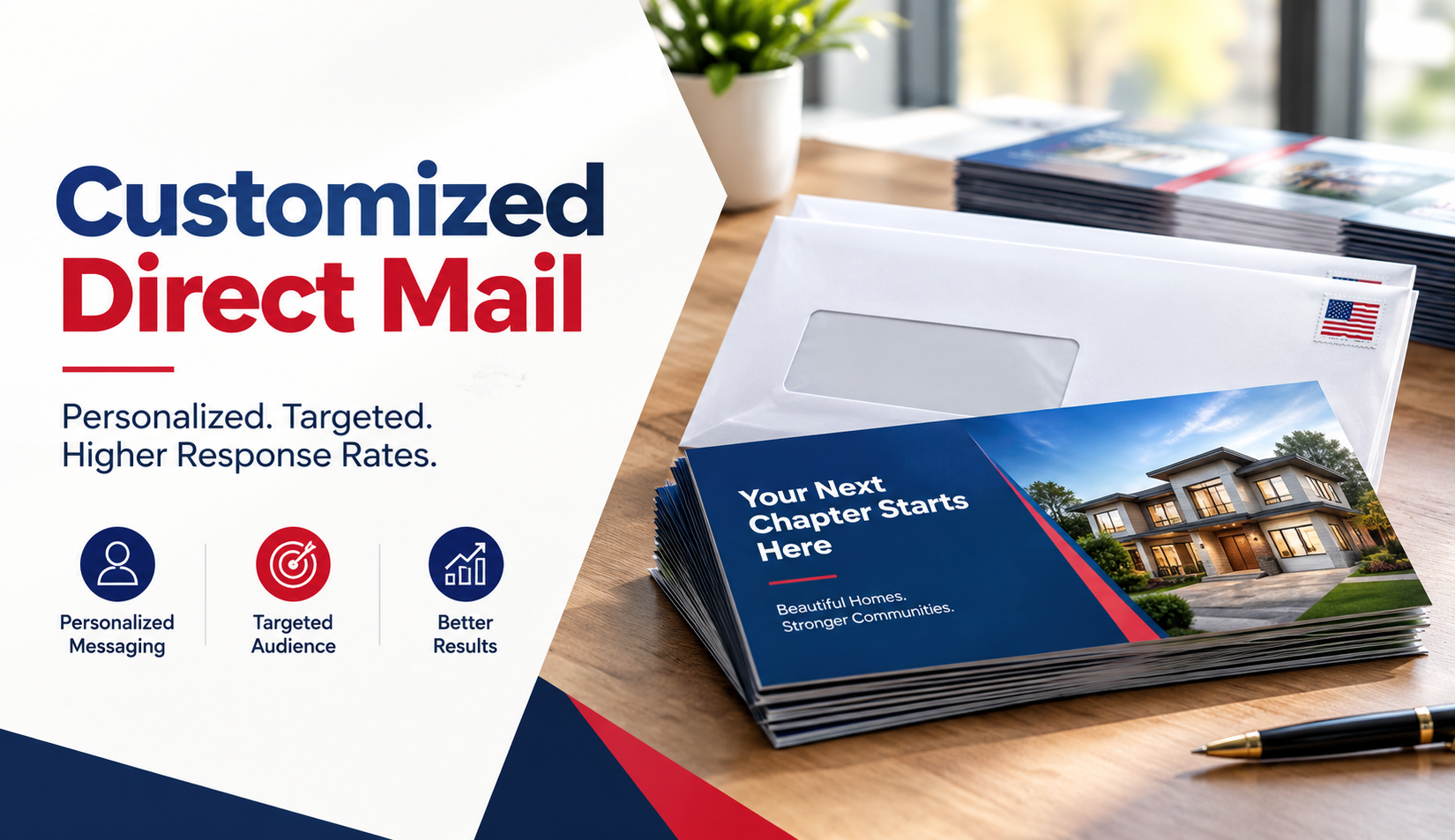
Used thoughtfully, Customized Direct Mail gives businesses a physical way to reconnect with customers, recognize their needs, and stay relevant without making every interaction feel like another sales pitch.
The key word here is customized. Printing a customer’s first name on a postcard does not automatically create a relationship. Strong direct mail starts with understanding why someone should hear from the business, what information matters to them, and what the next interaction should accomplish.
Customized Direct Mail Creates More Relevant Customer Conversations
Customers quickly notice when marketing has nothing to do with them.
A long-time customer does not need the same introduction as someone who has never purchased. A homeowner who recently bought a property may have different priorities from someone who has lived at the same address for 15 years. A customer who purchased last month should not receive the same message as someone who has been inactive for two years.
Customized campaigns let businesses account for those differences.
Start With Customer Context, Not Just a Mailing List
One of the most common problems we see happens before anything reaches the printing press. A business gathers thousands of addresses and immediately starts designing a postcard.
That sequence works backward.
Before creating the mailpiece, we recommend understanding who appears on the list. Useful customer groups might include:
-
Recent customers
-
Repeat customers
-
Former customers
-
New movers
-
Customers approaching a service renewal
-
People who requested information but never purchased
-
Customers associated with a particular location or service category
These groups do not need completely different brands or expensive creative concepts. They often need small changes in message, offer, imagery, or timing.
Those changes can make the communication feel far more appropriate.
Personalization Should Have a Reason
Personalization works best when it improves relevance.
For example, a dental practice might remind existing patients about preventive care rather than sending an introductory postcard about the office. An HVAC company can communicate differently with customers who recently installed equipment than with homeowners whose systems may require seasonal maintenance.
A retailer might recognize previous buyers with early information about a related product rather than sending every customer the same storewide promotion.
That distinction matters.
Customers rarely think, “This company used variable data printing.” They simply notice that the message makes sense.
Direct Mail Gives Customer Relationships a Physical Touchpoint
Digital marketing creates convenience, but it also creates enormous competition for attention.
Customers can delete an email without opening it. They can scroll past an advertisement in less than a second. Notifications compete with work messages, social feeds, videos, texts, and dozens of apps.
Physical mail creates a different interaction.
Someone picks it up. They look at it. They decide whether to keep it, use it, place it on the counter, or throw it away.
That extra moment gives businesses an opportunity that digital channels do not always provide.
Useful Mail Often Stays Around Longer
The most successful customer-retention mail does not always look like an advertisement.
A local service company might send a seasonal maintenance checklist. A veterinarian could mail a vaccination reminder. A restaurant might send an invitation tied to a customer occasion. A financial professional could provide a simple year-end preparation guide.
Useful information gives the customer a reason to hold onto the piece.
We often encourage businesses to ask one simple question before approving creative:
Would the recipient have any reason to keep this after reading it once?
If the answer is yes, the mailpiece has already moved beyond basic advertising.
Print Can Make Communication Feel More Deliberate
A well-designed postcard, letter, newsletter, or folded mailer carries physical weight. Paper choice, layout, photography, spacing, and message hierarchy all shape how customers interpret the communication.
That does not mean every piece needs luxury stock or elaborate finishing.
In many campaigns, clarity matters more.
Customers should understand who sent the mail, why they received it, and what they should do next within a few seconds. Good print design supports that process rather than decorating around it.
Consistent Direct Mail Helps Businesses Stay Familiar
Customer relationships rarely grow through one interaction.
Businesses sometimes treat direct mail as a single event: print 5,000 postcards, mail them, wait for responses, and decide whether the campaign worked.
That approach misses an important part of relationship marketing.
Familiarity develops over time.
Repetition Works Better When the Message Progresses
Sending the exact same advertisement three times can create recognition, but it can also become easy to ignore.
We prefer campaigns where each contact has a purpose.
A first piece might introduce a service or reconnect with a former customer. The next mailing can provide useful information, answer a common concern, or reinforce a benefit. A later piece can make a timely offer or encourage a specific action.
The customer still sees consistent branding, but the conversation moves forward.
This approach works particularly well when timing influences the buying decision. Businesses targeting people who recently relocated, for example, can use a 90-day new mover sequence instead of expecting one postcard to reach every household at the perfect moment.
Familiarity Should Not Become Frequency Without Purpose
More mail does not automatically create stronger relationships.
A customer who receives constant discounts may start waiting for the next coupon rather than buying at regular prices. A homeowner who receives irrelevant service reminders every few weeks may begin treating every envelope from the company as junk.
Frequency needs context.
We recommend building mailing schedules around genuine customer needs, buying cycles, service intervals, seasons, events, or meaningful milestones.
That gives each contact a reason to exist.
Customized Direct Mail Can Support Customer Retention
Many businesses spend aggressively on customer acquisition while giving retention much less attention.
That imbalance can become expensive.
Once a customer already knows the company, the next communication does not need to overcome the same level of unfamiliarity. The business can build from an existing experience.
Direct mail gives companies several practical ways to continue that relationship.
Reconnect Before Customers Drift Away
Customer databases often contain people who once bought regularly and then quietly disappeared.
Businesses sometimes assume those customers left because of a negative experience. In reality, many simply forgot, moved, changed routines, postponed a purchase, or encountered a competitor at the right time.
A thoughtful reactivation mailer can reopen that relationship.
The message does not always need a major discount. Sometimes a simple reminder, product update, service message, or invitation gives the customer enough reason to return.
The tone matters here.
“Come back and save 40%” feels very different from “We haven’t seen you in a while, and here’s what has changed.”
The right approach depends on the business and customer history.
Recognize Existing Customers Differently
Few things make loyal customers feel less valued than receiving a “new customer only” offer from a company they have supported for years.
Data segmentation helps prevent that mistake.
Existing customers can receive:
-
Loyalty offers
-
Service reminders
-
Anniversary messages
-
Early access
-
Referral invitations
-
Related product information
-
Thank-you communications
-
Renewal notices
None of these tactics require aggressive selling.
They simply recognize that an existing relationship already exists.
Timing Often Matters More Than Fancy Personalization
Businesses sometimes become fascinated with how much information they can place into a personalized mailpiece.
We usually ask a different question:
When should the customer receive it?
Perfect personalization at the wrong time still produces weak communication.
Connect Mailings to Real Customer Moments
The strongest mailing opportunities often come from ordinary business data.
An auto repair shop knows approximately when certain maintenance needs may return. A salon knows how frequently many clients book. An insurance agency tracks policy renewal periods. A home-service company can identify seasonal demand.
These signals help businesses communicate at moments when customers have a realistic reason to care.
That often produces a better experience than sending another generic “10% off” postcard.
Life Events Can Create Natural Contact Points
Certain changes create new purchasing needs.
Moving provides an obvious example. New residents start looking for restaurants, healthcare providers, contractors, gyms, pet services, cleaners, retailers, and other local businesses.
Other events can create similar opportunities, depending on the customer data available and the business involved.
The goal should never involve showing customers how much a company knows about them.
Good personalization feels useful, not intrusive.
Strong Direct Mail Requires Clean Customer Data
Creative design cannot rescue poor data.
We regularly see businesses spend time debating colors, headlines, paper stocks, and promotional offers while giving very little attention to the mailing file itself.
That creates unnecessary waste.
Remove Problems Before Printing
Before preparing a customer mailing, businesses should review their records for issues such as:
-
Duplicate contacts
-
Incomplete addresses
-
Outdated customer information
-
Customers outside the current service area
-
Incorrect customer categories
-
Records that should no longer receive marketing
-
Inconsistent name or address formatting
A cleaner list improves more than delivery.
It also protects the customer experience. Sending duplicate postcards to the same household or mailing an irrelevant message because of incorrect segmentation can make a brand look careless.
Collect Information the Business Can Actually Use
More customer data does not always mean better marketing.
We would rather see a business maintain five reliable fields than 25 inconsistent ones.
Useful information may include the customer's location, last purchase date, service type, customer status, preferred location, or another detail that directly affects future communication.
Every data point should answer a practical question.
How will this help us send something more useful?
If nobody can answer that question, the business may not need that information for direct mail.
Good Direct Mail Strengthens Trust Through Consistency
Customers notice small inconsistencies.
They notice when an offer on a postcard differs from what employees know at the store. They notice when a QR code opens the wrong page. They notice when an expiration date creates confusion or when an outdated phone number appears on printed material.
These mistakes seem minor during campaign production. They do not feel minor to the customer.
Keep the Experience Consistent After the Mailbox
The mailpiece represents only the beginning of the customer interaction.
Before mailing, businesses should check every response path:
-
Phone numbers
-
Website addresses
-
QR codes
-
Landing pages
-
Coupon codes
-
Store instructions
-
Appointment links
-
Offer terms
-
Expiration dates
Staff members should also know about the campaign.
We have seen well-designed marketing lose momentum simply because the customer called and the person answering the phone did not recognize the offer.
Marketing and operations need to connect.
Make Offers Easy to Understand
Complicated offers rarely strengthen relationships.
Customers should not need to study fine print to understand what they receive.
A clear offer usually answers four questions quickly:
-
What do I receive?
-
Why should I care?
-
What do I need to do?
-
When do I need to act?
If the business cannot explain the offer simply, the customer may struggle too.
Combining Direct Mail With Digital Channels Improves the Customer Journey
Direct mail does not need to compete with digital marketing.
The two channels can support each other.
A postcard can lead customers to an appointment page. A printed catalog can direct shoppers toward an online collection. A letter can include a QR code for account access. A loyalty mailer can encourage customers to join an email or SMS program.
The important part comes from continuity.
Keep the Message Consistent Across Channels
Customers should not feel as though two different companies created the postcard and landing page.
Use similar language, imagery, offers, and calls to action.
If the mailpiece promises a free consultation, the landing page should immediately explain how to request it. If a postcard promotes a specific product category, the QR code should not send customers to the general homepage.
Removing unnecessary steps respects the customer’s time.
Give Customers More Than One Response Option
Not every customer wants to scan a QR code.
Some prefer calling. Others want to visit a website, walk into a location, redeem a physical coupon, or schedule online.
When practical, direct mail should offer more than one sensible response path.
That flexibility can make the interaction feel more customer-friendly without adding much complexity to the campaign.
How We Approach Relationship-Focused Direct Mail Campaigns
When we discuss customized mail with businesses, we try to move the conversation away from “What size postcard should we print?” until we understand the campaign itself.
Printing specifications matter, but strategy should lead them.
Define One Primary Customer Goal
Every mailpiece should have one main job.
Perhaps the business wants customers to schedule annual maintenance. Maybe it wants former customers to return, new residents to visit, or existing buyers to consider another service.
Trying to accomplish five objectives on one postcard usually weakens all five.
Choose the priority first.
Match the Format to the Message
A postcard works well when the message needs quick visibility.
A letter gives businesses more room for explanation. A folded piece can support several products, services, or educational points. A newsletter can help companies maintain longer-term customer communication.
We choose format after understanding how much the customer genuinely needs to know.
More space does not mean the business should fill every inch.
White space often improves comprehension.
Measure More Than Immediate Sales
Businesses understandably want revenue from marketing.
Still, relationship-focused campaigns may influence several behaviors before a purchase occurs.
Useful measurements can include:
-
Coupon redemptions
-
QR code visits
-
Phone inquiries
-
Appointment requests
-
Website sessions
-
Return visits
-
Reactivated customers
-
Repeat purchases
-
Referral activity
Tracking these responses helps businesses understand which messages encourage customers to re-engage.
Over time, those insights can improve both the mailing strategy and the broader customer experience.
Common Direct Mail Mistakes That We See Businesses Make
Some campaign problems repeat across industries.
Understanding them early saves businesses from wasting print, postage, and customer attention.
Mailing Everyone the Same Message
The largest available list does not always create the best campaign.
A smaller, relevant segment often gives the business a clearer message and a more meaningful reason to contact customers.
Leading With the Discount Every Time
Discounts can generate action, but constant discounts can train customers to ignore anything that does not include one.
Educational content, reminders, invitations, service updates, and customer recognition can create valuable communication without reducing price.
Designing Before Defining the Audience
An attractive postcard cannot compensate for unclear strategy.
We prefer to know the recipient, purpose, offer, timing, and desired action before working through visual decisions.
Treating One Mailing as the Whole Strategy
One postcard can generate responses, but customer relationships rarely depend on one contact.
Businesses usually gain more insight when they think in sequences, customer stages, and future touchpoints instead of isolated campaigns.
FAQs
How Does Customized Direct Mail Help With Customer Retention?
Customized direct mail lets businesses communicate according to customer history, timing, location, or service needs instead of sending the same promotion to everyone. Relevant reminders, loyalty messages, useful information, and reactivation campaigns can keep the relationship active between purchases.
What Information Can Businesses Personalize in a Direct Mail Campaign?
Businesses can personalize names, offers, images, service information, location details, customer status, purchase-related messaging, QR codes, and calls to action when their data supports those elements. We recommend using only information that improves the customer experience rather than personalizing simply because the technology allows it.
How Often Should a Business Send Direct Mail to Existing Customers?
No single frequency works for every business. The right schedule depends on buying cycles, service intervals, seasonality, customer behavior, and campaign purpose. A useful reminder at the right time usually carries more value than frequent mail with no clear reason behind it.
Can Direct Mail Work Together With Email and Digital Marketing?
Yes. Direct mail can guide customers toward landing pages, appointment systems, online stores, email programs, and other digital touchpoints. Businesses usually create a smoother experience when the mailpiece and digital destination carry the same message, offer, imagery, and next step.
A Better Direct Mail Relationship Starts With Relevance
The best customized direct mail does not make customers feel targeted.
It makes them feel understood.
That difference comes from disciplined choices: clean data, sensible segmentation, relevant timing, clear offers, useful information, thoughtful creative, and a response process that works after the customer takes action.
We have found that businesses get more value from direct mail when they stop asking, “How can we advertise to this list?” and start asking, “What would actually help this customer right now?”
That change in thinking improves more than the mailpiece. It creates better customer communication.
For businesses planning a retention campaign, reactivation program, customer mailing, or multi-touch direct mail strategy, MailProsUSA can help connect targeting, printing, mailing, and campaign execution into one practical workflow.
The goal should never involve sending more mail simply for the sake of visibility. The goal should involve sending the right message often enough that customers remember the business when they actually need it.


 Arabic
 Français
 Español
 Português
 Deutsch
 Türkçe
 Dutch
Dutch
 Italiano
 Russian
 Romaian
 Portuguese (Brazil)
 Greek
Greek