


DISC Personality Testing Explained: How It Reveals Your Work Style
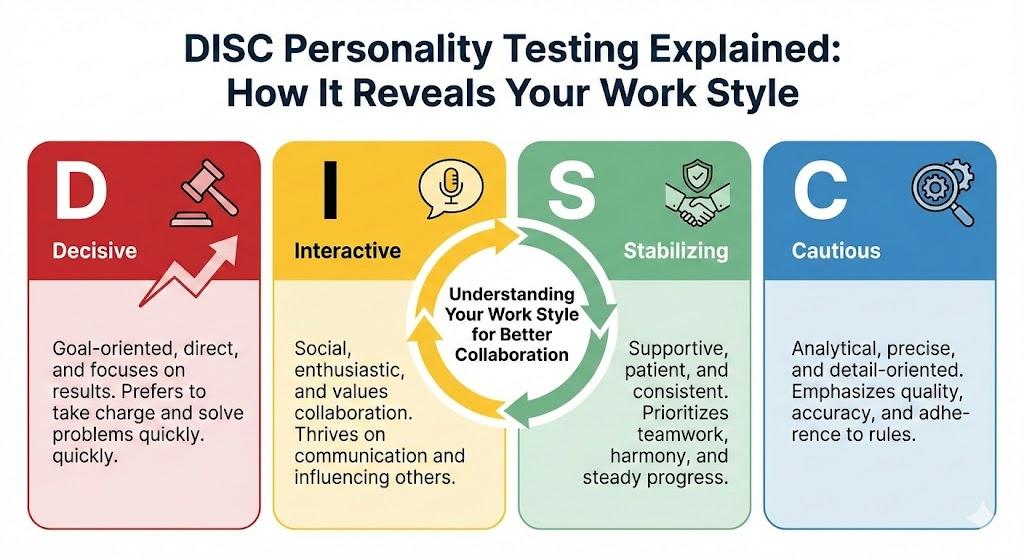
DISC Personality Testing is one of the most practical tools used by organizations to understand how individuals behave, communicate, and perform in the workplace. Rather than focusing on deep psychological traits, DISC highlights observable behavior—how people make decisions, interact with others, handle change, and respond to structure. By identifying distinct work styles, DISC helps individuals improve self-awareness and enables teams to collaborate more effectively.
In today’s fast-paced and diverse work environments, understanding behavioral differences is no longer optional. DISC Personality Testing offers a simple yet powerful framework that translates human behavior into actionable workplace insights.
What Is DISC Personality Testing?
DISC Personality Testing is a behavioral assessment model built around four core styles:
-
Decisive (D)
-
Interactive (I)
-
Stabilizing (S)
-
Cautious (C)
Each style represents a distinct way of approaching work, communication, and problem-solving. Everyone has a combination of all four traits, but most individuals have one or two dominant styles that shape their natural work behavior.
Unlike personality tests that attempt to define who you are, DISC focuses on how you behave, especially in professional settings. This makes it highly relevant for leadership development, communication training, and team performance.
Why DISC Personality Testing Matters in the Workplace
DISC Personality Testing is widely used because it is easy to understand, non-judgmental, and immediately applicable. There are no “right” or “wrong” styles—each DISC type brings value to the workplace.
Organizations rely on DISC to:
-
Improve communication and collaboration
-
Reduce workplace conflict
-
Develop stronger leaders
-
Align roles with natural work styles
-
Build balanced, high-performing teams
When employees understand their own DISC style and the styles of others, misunderstandings decrease and productivity increases.
The Four DISC Styles and Their Work Behaviors
Decisive (D): The Results-Focused Work Style
Individuals with a Decisive (D) style are bold, confident, and goal-oriented. They thrive on challenges and prefer taking control of situations to achieve results quickly.
Work style traits:
-
Direct and assertive
-
Action-driven and competitive
-
Comfortable making tough decisions
-
Focused on outcomes over processes
Strengths in the workplace:
-
Strong leadership presence
-
Fast decision-making
-
Ability to drive progress and change
Potential challenges:
-
May appear impatient or overly demanding
-
Can overlook details or team input
-
May struggle with collaboration if slowed down
Decisive individuals excel in leadership roles, sales, entrepreneurship, and environments that reward initiative and accountability.
Interactive (I): The Engaging Work Style
The Interactive (I) style is people-focused, energetic, and enthusiastic. These individuals bring optimism and creativity to the workplace and enjoy building relationships.
Work style traits:
-
Expressive and outgoing
-
Motivated by recognition and connection
-
Strong verbal communicators
-
Thrive in collaborative settings
Strengths in the workplace:
-
Inspiring team morale
-
Effective persuasion and influence
-
Creative problem-solving
Potential challenges:
-
May struggle with organization or follow-through
-
Can overlook details
-
May prioritize relationships over results
Interactive personalities perform well in marketing, customer-facing roles, training, and team leadership positions.
Stabilizing (S): The Supportive Work Style
People with a Stabilizing (S) style value consistency, teamwork, and harmony. They are dependable contributors who prioritize long-term success over quick wins.
Work style traits:
-
Calm, patient, and reliable
-
Loyal to teams and organizations
-
Prefer predictable routines
-
Strong listeners
Strengths in the workplace:
-
Excellent team players
-
Consistent performance
-
Strong relationship-building skills
Potential challenges:
-
May resist rapid change
-
Can avoid conflict
-
Might hesitate to assert opinions
Stabilizing individuals thrive in roles such as HR, operations, customer support, and project coordination.
Cautious (C): The Analytical Work Style
The Cautious (C) style is analytical, detail-oriented, and quality-driven. These individuals value accuracy, logic, and structure in their work.
Work style traits:
-
Methodical and precise
-
Data-driven decision-makers
-
Prefer clear rules and expectations
-
High standards for quality
Strengths in the workplace:
-
Strong analytical and problem-solving skills
-
Attention to detail
-
Risk awareness and compliance
Potential challenges:
-
May overanalyze decisions
-
Can struggle with ambiguity
-
May appear reserved or critical
Cautious personalities are well suited for roles in finance, engineering, research, IT, and compliance-driven industries.
How DISC Personality Testing Reveals Your Work Style
DISC Personality Testing measures how individuals respond to common workplace situations, including:
-
Pressure and challenges
-
Interactions with others
-
Pace of work
-
Structure and rules
The results typically show a person’s natural style and their adapted style, revealing how behavior changes in professional environments. This insight helps individuals understand why certain tasks feel energizing while others feel draining.
By recognizing these patterns, people can:
-
Improve communication effectiveness
-
Reduce stress and burnout
-
Leverage strengths more intentionally
-
Address blind spots
DISC Personality Testing and Workplace Communication
One of the biggest advantages of DISC Personality Testing is its impact on communication. Miscommunication often happens not because of intent, but because of differing behavioral styles.
For example:
-
Decisive (D) styles prefer concise, results-focused conversations
-
Interactive (I) styles respond best to enthusiasm and open dialogue
-
Stabilizing (S) styles appreciate patience and reassurance
-
Cautious (C) styles value facts, logic, and preparation
When teams adapt communication based on DISC styles, collaboration becomes smoother and more respectful.
Using DISC for Leadership Development
Effective leaders understand that people are motivated differently. DISC Personality Testing equips leaders with the insight needed to adjust their leadership approach.
Leaders can use DISC to:
-
Delegate tasks more effectively
-
Coach employees based on behavioral needs
-
Resolve conflict with empathy
-
Build trust and engagement
A leader who understands DISC creates an environment where diverse work styles are seen as strengths, not obstacles.
DISC Personality Testing in Teams and Hiring
DISC Personality Testing is especially valuable for team development. It highlights behavioral gaps and strengths within teams, helping organizations build balance.
While DISC should not be used to eliminate candidates, it is highly effective for:
-
Onboarding and role alignment
-
Team-building workshops
-
Professional development planning
-
Improving collaboration
Used responsibly, DISC supports growth rather than limiting opportunity.
What DISC Personality Testing Is—and Is Not
DISC Personality Testing is not:
-
A measure of intelligence or competence
-
A psychological diagnosis
-
A predictor of success by itself
DISC Personality Testing is:
-
A behavioral awareness tool
-
A communication framework
-
A guide for professional development
Its true value lies in how it is applied, not how it is labeled.
Conclusion
DISC Personality Testing provides a clear and actionable way to understand work style through the lens of Decisive, Interactive, Stabilizing, and Cautious behaviors. By focusing on how people act rather than who they are, DISC promotes self-awareness, better communication, and stronger teamwork.
In a workplace where collaboration and adaptability matter more than ever, DISC Personality Testing remains a powerful tool for building productive, engaged, and high-performing teams.



 English
 Arabic
 French
 Portuguese
 Deutsch
 Turkish
 Dutch
Dutch
 Italiano
 Russian
 Romaian
 Portuguese (Brazil)
 Greek
Greek