


Insurance Score vs Credit Score: Key Differences Explained
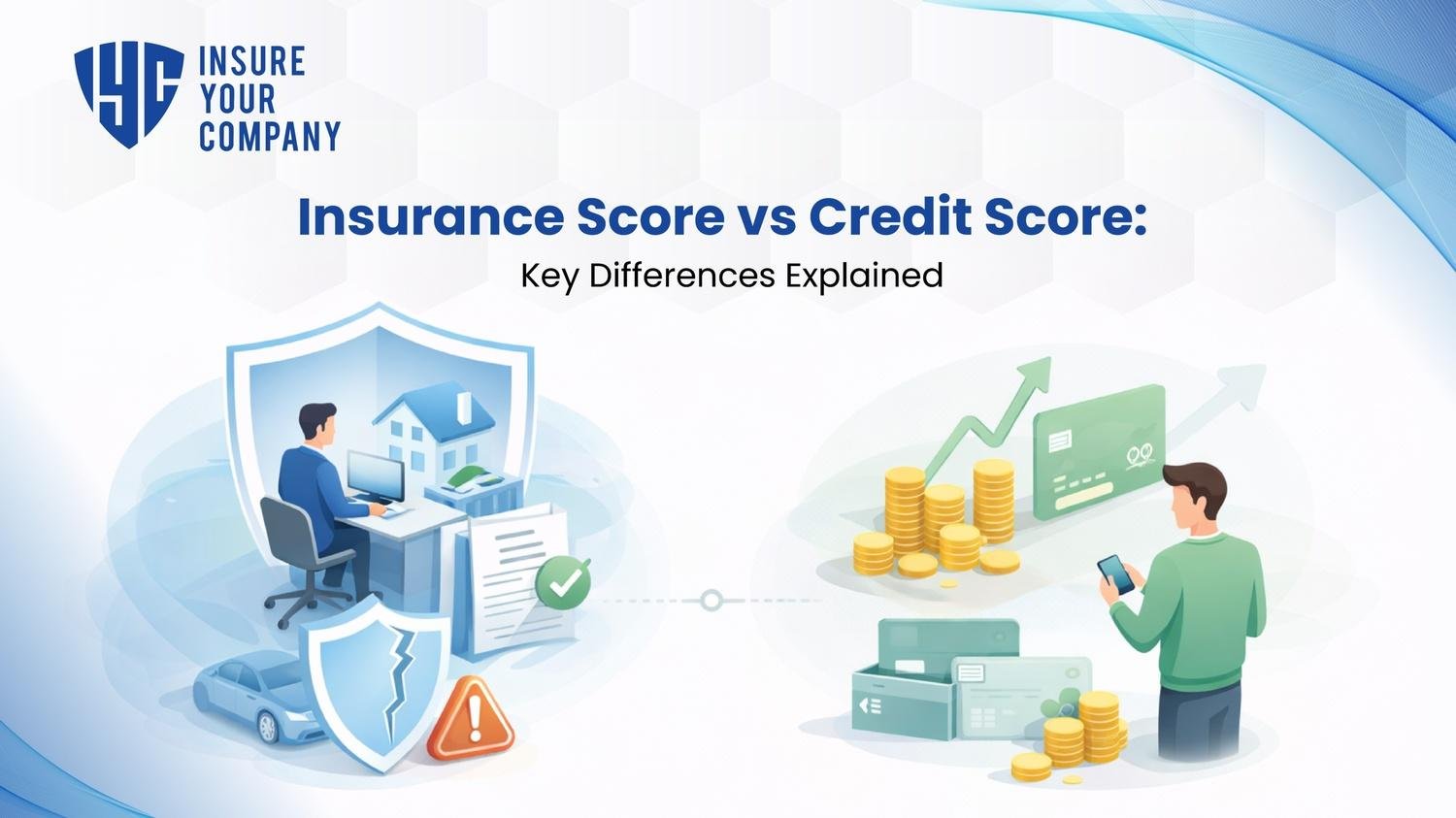
Before taking out a loan, most people check their credit score. What they rarely check — or even know about — is the score insurance companies use when deciding what to charge them for coverage.
These are two different numbers built for two different purposes. Yet most business owners treat them as the same thing, or worse, assume their credit score is the only number that matters when renewing a policy.
At InsureYourCompany, we work with business owners every day who are caught off guard by this distinction. Some discover it only after a premium increase they did not expect. This article breaks down both scores clearly — what each one measures, where they differ, and what actually drives your insurance costs up or down.
What Is an Insurance Score?
An insurance score is a number insurers use to judge how likely you are to file a claim. That sounds simple, but the way it works is often misunderstood. It pulls from the same credit report data that lenders use — but it does not ask the same question.
What Is a Credit Score?
A credit score is a three-digit number that tells lenders how reliably you repay what you borrow. It sits at the centre of almost every major financial decision a lender makes about you.
What Is the Difference Between Insurance Score and Credit Score?
The difference between insurance score and credit score comes down to purpose, audience, and what each one predicts.
Both scores pull from the same credit report data, but they ask different questions of that data. A credit score asks: Will this person repay their debt? An insurance score asks: Will this person file claims that cost more than they pay in premiums?
|
Factor |
Credit Score |
Insurance Score |
|
Primary purpose |
Predict debt repayment |
Predict insurance claim likelihood |
|
Used by |
Banks, lenders, creditors |
Insurance carriers and underwriters |
|
Regulated by |
Federal law |
State law — varies by state |
|
Score range |
300–850 (FICO) |
200–997 (LexisNexis); varies by model |
|
Can deny coverage alone |
Yes, for loans |
No — cannot be the sole reason for denial |
|
Consumer access |
Available via free annual report |
Request from insurer or LexisNexis |
|
Affected by insurance quotes |
No |
No — soft inquiry only |
One practical distinction worth noting: insurers cannot use your insurance score as the sole reason to deny you coverage or cancel a policy. Most states require it to function as one factor among several — not a standalone decision maker.
How Does an Insurance Score Affect Premiums?
How insurance score affects premiums is direct: a higher score signals lower predicted risk, which results in lower premium costs. A lower score signals higher predicted risk, which leads to higher premiums.
Insurance companies use the score during two stages. The first is underwriting — where they decide whether to offer you coverage at all and which risk pool to place you in. The second is rating, where they determine the exact premium amount based on the risk profile your score reflects.
Here is how the main scoring factors are weighted in a typical FICO insurance scoring model:
-
Payment history: Accounts for the largest portion of your score. Consistent, on-time payments across all credit accounts signal responsible financial management.
-
Outstanding debt: High balances relative to available credit reduce your score. Keeping credit card utilisation low helps both your credit score and your insurance score.
-
Credit history length: Longer credit histories are viewed more favourably. A long track record of responsible credit use builds confidence in your risk profile.
-
Pursuit of new credit: Applying for multiple new credit accounts in a short period can lower your score temporarily.
-
Credit mix: A range of account types — mortgage, auto loan, credit card — tends to support a healthier score.
Insurers cannot use income, age, gender, ethnicity, nationality, or address to calculate your insurance score. These factors are excluded from the scoring model by law. However, some of those factors — such as age and location — may be used separately by the insurer when setting your overall premium outside the scoring model.
How Does an Insurance Score Work in Practice?
A small business owner applies for a commercial property policy. The insurer pulls their credit report and generates an insurance score. The owner has a long credit history, low outstanding balances, and a clean payment record. Their insurance score comes back strong.
The insurer places them in a lower-risk category, which results in a more competitive premium. Another business owner with the same property, in the same location, with an identical claims history but a shorter credit history and higher balances receives a higher premium — because their insurance score places them in a different risk band.
Neither denial is based on the insurance score alone. Both receive coverage. But the premium difference between the two can be meaningful over a full policy year.
Can You Improve Your Insurance Score?
Yes — and the steps that improve your insurance score are largely the same ones that improve your credit score. The two scores share the same underlying data.
-
Pay all bills on time, including utilities and subscriptions where these appear on your credit report.
-
Reduce balances on revolving credit accounts to lower your credit utilisation.
-
Avoid opening multiple new credit accounts in a short period.
-
Review your credit report annually and dispute any errors — inaccuracies on your credit report directly affect your insurance score.
-
Contact your insurer if your financial situation changed due to a major life event. Many insurers will reconsider your premium if you can show evidence of a significant circumstance such as job loss, illness, or a major unexpected expense.
How InsureYourCompany Helps You Understand What Drives Your Premium
Most business owners pay their premiums without knowing what went into calculating them. Insurance scores, claims history, credit behaviour, industry classification — each of these plays a role, and understanding them puts you in a stronger position to manage your costs.
InsureYourCompany has been helping businesses across New Jersey and nationwide build better-informed coverage since 2001. Our licensed agents explain what affects your premium, help you identify ways to improve your risk profile, and make sure you are not overpaying for the coverage your business needs.
Unsure what drives your premium? Reach us at insureyourcompany today — we will break it down for you.



 English
 Arabic
 Français
 Español
 Português
 Deutsch
 Dutch
Dutch
 Italiano
 Russian
 Romaian
 Portuguese (Brazil)
 Greek
Greek