


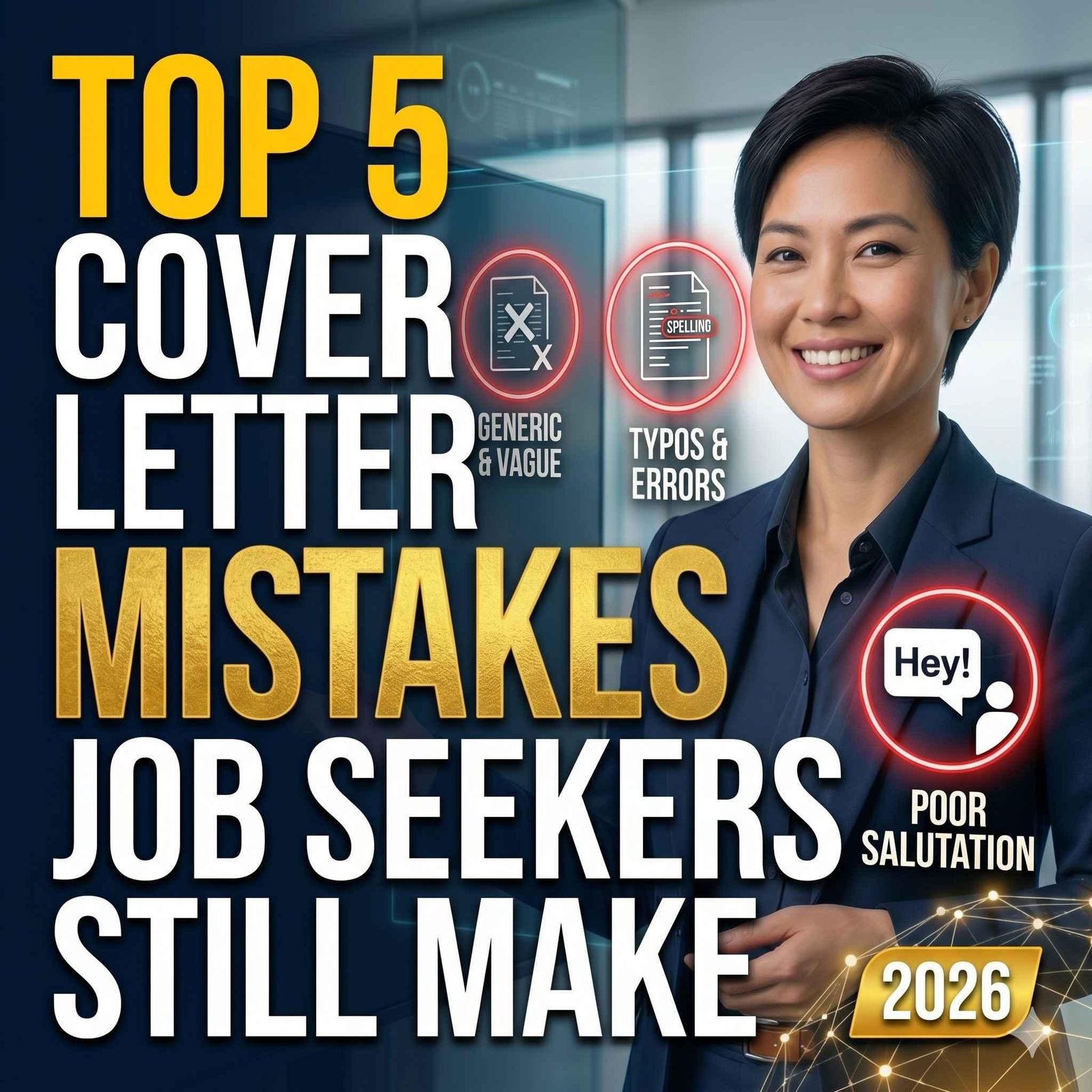
Top 5 Coverletter Mistakes Job Seekers Still Make in 2026
In today’s hiring market, resumes are not the only thing recruiters pay attention to anymore. A strong coverletter can still influence hiring decisions, especially in competitive industries where employers want to understand the person behind the application.
Yet many job seekers continue making the same mistakes repeatedly.
Some candidates submit generic cover letters copied from the internet. Others skip the coverletter entirely, assuming recruiters never read them.
That assumption is risky in 2026.
Modern recruitment combines:
-
AI screening
-
ATS filtering
-
Human evaluation
-
Communication assessment
This means your application package needs more than just an optimized resume. Your coverletter also plays a major role in how recruiters perceive your professionalism, motivation, and communication style.
In this guide, we break down the top coverletter mistakes job seekers still make — and how to fix them effectively.
Why Coverletters Still Matter in 2026?
Many candidates believe ATS systems only scan resumes.
That is no longer true.
Modern hiring platforms increasingly analyze:
-
Resume relevance
-
Communication quality
-
Writing clarity
-
Keyword alignment
-
Application consistency
This is why both resumes and coverletter content now contribute to hiring outcomes.
Combined with proper ATS resume optimization, a strong application package improves your chances of getting shortlisted.
What Hiring Managers Actually Want From a Coverletter?
Recruiters do not want long essays.
They want quick answers to:
-
Why are you applying?
-
Why are you suitable?
-
What value can you bring?
-
Why this company?
A strong cover letter should feel:
-
Personalized
-
Clear
-
Professional
-
Human
-
Relevant
Hiring managers are looking for authenticity, not robotic templates.
Top 5 Coverletter Mistakes Job Seekers Still Make
1. Sending Generic Coverletters Everywhere ❌
This is still the biggest mistake in 2026.
Many candidates use the same cover letter for every job application without changing:
-
Company name
-
Role details
-
Skills relevance
-
Industry language
Recruiters immediately recognize generic applications.
Weak Example:
“I am excited to apply for this role at your company.”
This says almost nothing.
Better Example:
“I am excited to apply for the Digital Marketing Specialist role because of your company’s focus on AI-driven customer engagement strategies.”
Specificity matters.
Pro Tip:
Customize:
-
Opening paragraph
-
Keywords
-
Skills references
-
Closing statement
Tailored applications perform much better.
2. Ignoring ATS Resume Optimization Keywords 🔍
Many candidates optimize resumes but completely ignore the coverletter.
That is a mistake.
Modern ATS systems increasingly scan both documents together.
Without relevant keywords, your application relevance may decrease.
Include Keywords Naturally:
-
Job title
-
Industry skills
-
Technical expertise
-
Tools mentioned in job descriptions
Strong ATS resume optimization should extend to your cover letter strategy too.
3. Writing Long, Boring Paragraphs 📄
Recruiters spend very little time reviewing applications.
Huge blocks of text reduce readability.
Common Problems:
-
Long introductions
-
Repeated information
-
Over-explaining experience
-
Generic storytelling
Better Structure:
|
Section |
Purpose |
|
Opening |
Why you are applying |
|
Middle |
Skills and achievements |
|
Closing |
Interest and next steps |
Keep your coverletter concise and focused.
Ideal length:
-
250–400 words
Shorter and sharper usually performs better.
4. Focusing Only on Responsibilities Instead of Results
Recruiters want impact, not task lists.
Weak Example:
-
Managed marketing campaigns
Better Example:
-
Increased lead generation by 38% through targeted LinkedIn campaigns
Achievements create stronger credibility.
Hiring managers want measurable value such as:
-
Revenue growth
-
Process improvement
-
Engagement increase
-
Cost savings
-
Team performance
Your coverletter should highlight business impact, not just job duties.
5. Forgetting Human Personality
Many AI-generated applications sound robotic now.
Hiring managers can easily identify:
-
Overused phrases
-
Generic AI wording
-
Emotionless writing
-
Overly formal tone
A good coverletter should still sound human.
Professional does not mean cold.
Better Approach:
Write naturally while remaining professional.
Show:
-
Genuine enthusiasm
-
Career motivation
-
Industry interest
-
Confidence
Human connection still matters in recruitment.
The Role of ATS Score Checker Tools
Today, many professionals use an ATS score checker before applying for jobs.
These tools help identify:
-
Missing keywords
-
Formatting problems
-
ATS compatibility issues
-
Resume-job alignment gaps
However, candidates often forget that application quality goes beyond the resume itself.
Your coverletter should complement your ATS strategy instead of being treated as an afterthought.
What Makes a Strong Coverletter in 2026?
Key Elements Recruiters Prefer
|
Element |
Importance |
|
Personalization |
High |
|
Relevant keywords |
High |
|
Clear structure |
High |
|
Measurable achievements |
High |
|
Human tone |
High |
|
Concise writing |
High |
Strong applications balance professionalism with personality.
Trending Hiring Updates in 2026
AI Screening Is Increasing
Companies now use AI to:
-
Analyze writing clarity
-
Match candidate relevance
-
Detect keyword alignment
-
Evaluate communication quality
That means low-quality generic applications stand out negatively.
Skills-First Hiring Is Growing
Recruiters increasingly prioritize:
-
Skills
-
Results
-
Portfolio quality
-
Adaptability
…over traditional credentials alone.
Communication Skills Matter More
Strong communication is now considered a core professional skill across industries.
A well-written coverletter demonstrates:
-
Clarity
-
Confidence
-
Professionalism
-
Attention to detail
Related Tips for Job Seekers 💡
Match Your Resume and Coverletter
Ensure:
-
Job titles align
-
Skills match
-
Dates remain consistent
Avoid Overusing AI Content
Use AI tools for support, not full replacement.
Human editing is essential.
Keep Formatting Simple
Use:
-
Standard fonts
-
Clean spacing
-
Professional structure
Focus on Results
Quantifiable achievements improve credibility significantly.
Frequently Asked Questions (FAQ)
Are cover letters still important in 2026?
Yes. Many recruiters still evaluate a coverletter to understand candidate motivation, communication skills, and cultural fit.
Can ATS systems read cover letters?
Yes. Modern ATS systems increasingly scan both resumes and cover letters during application review.
What is ATS resume optimization?
ATS resume optimization is the process of improving resumes for better Applicant Tracking System compatibility and ranking.
Should I use an ATS score checker?
Yes. An ATS score checker helps identify optimization issues before applying.
How long should a coverletter be?
Ideally:
-
250–400 words
-
Short
-
Clear
-
Personalized
Final Thoughts
The hiring process in 2026 is becoming more competitive, AI-driven, and communication-focused.
A strong application now requires:
-
An optimized resume
-
A professional coverletter
-
Smart keyword strategy
-
Human-centered communication
Candidates who combine personalization with proper ATS resume optimization usually stand out faster during recruitment.
That is why many professionals are now using tools like JD match to improve ATS alignment, optimize applications, and create stronger job-ready profiles before applying.


 English
 Arabic
 Français
 Español
 Português
 Deutsch
 Dutch
Dutch
 Italiano
 Russian
 Romaian
 Portuguese (Brazil)
 Greek
Greek