


Throughout my career, from leading high-impact teams within the world’s premier Spanish-language media powerhouse, to driving strategic growth at a Fortune 100 financial services company, to serving as CEO of technology consultancies, and now advising growth-stage companies, I have watched leadership teams navigate multiple waves of transformation. While the technologies have changed, one question has remained remarkably consistent:
How do you grow a business while preserving the qualities that made it successful in the first place?
For many years, the answer centered on adding capacity. As revenue increased, companies hired more people, introduced additional management layers, expanded departments, and invested in systems to coordinate increasingly complex organizations. It was an effective model because it reflected the realities of its time.
From Adding Capacity to Amplifying Capability
Today, we are shifting from an era of headcount expansion to one of Operational Arbitrage. Mid-market CEOs have access to a new set of capabilities that allow them to think differently about growth. Artificial intelligence, automation, and decision intelligence are enabling companies with $5 million to $150 million in revenue to operate with a level of sophistication that was once reserved for much larger enterprises.
Certainly, there is an opportunity to adopt new technology. However, there’s an even greater opportunity to build a new operating system for leadership — one designed around leverage, learning, and disciplined execution.
One truth has held across every organization I’ve worked with: the highest-performing organizations rarely have the most activity. They have the greatest clarity. Everyone understands priorities, decisions happen quickly, and execution follows naturally.
That clarity creates leverage.
“The highest-performing organizations rarely have the most activity. They have the greatest clarity”
Historically, scale was achieved by expanding capacity. Today, scale is increasingly achieved by amplifying capability. This subtle shift has profound implications for how CEOs think about organizational design, operational excellence, and long-term enterprise value.
The Mid-Market Performance Gap
Research shows that 84% of private equity firms expect AI to transform the bussiness [Pfeifer, D. (2025, November 7)] they invest in, while only 11.9% of smaller companies [Calvino, F., Bianchini, M., Lane, M., Montegu, J., Verger, V., & Ancheva, S. (2025)] have adopted AI. Large enterprises are adopting AI at 3.4 times the rate of smaller organizations. Together, these trends create a meaningful opportunity for CEOs who approach AI as a business strategy rather than simply a technology initiative.
For me, the conversation begins with a different question.
Stop Asking Where to Use AI. Ask Where to Create Leverage.
“Stop asking where to use AI. Ask where to create leverage.”
Leverage appears in many forms. It enables finance teams to spend more time interpreting business performance and less time assembling reports. It allows sales organizations to prepare proposals more efficiently while improving consistency. It helps operations teams streamline repetitive coordination so they can focus on continuous improvement. Most importantly, it gives leaders access to better information that supports thoughtful, timely decisions.
These improvements are valuable individually. Together, they strengthen the operating rhythm of the entire business.
Institutional Memory as a Strategic Asset
One pattern I have observed across organizations of every size is that their greatest assets often exist in conversations. Customer context, implementation decisions, pricing rationale, operational judgment, and lessons learned frequently reside with experienced team members instead of becoming part of the organization’s permanent capability.
Capturing that institutional knowledge has always been valuable. Today, it is also practical.
AI makes it possible to preserve organizational knowledge in ways that accelerate onboarding, improve decision quality, and allow every team to build upon previous experience. Over time, Institutional Capital becomes a strategic asset that compounds rather than resets as organizations grow.
Many leadership teams have invested in dashboards over the past decade, and they continue to play an important role. Increasingly, however, CEOs have the opportunity to move beyond reporting toward decision intelligence by combining operational data, forecasting, and scenario analysis to evaluate options before resources are committed. Executive conversations become less about understanding what happened and more about determining what will create the greatest value next.
Over the past several years, I have also noticed that conversations about AI often begin with technology.
I believe they become more valuable when they begin with enterprise value.
The AI-to-EBITDA Conversion
That perspective has led me to evaluate every AI initiative through a single lens: its contribution to EBITDA.
Technology investments should not be evaluated by the number of pilots completed or tools deployed. They should be evaluated by Outcome-Based Innovation.
- Has revenue per employee increased?
- Has the proposal process become more efficient?
- Have customer onboarding cycles accelerated?
- Are leaders spending more time coaching and less time coordinating?
- Is the business becoming more profitable because work flows more effectively across the organization?
These are the questions that connect innovation directly to enterprise value.
McKinsey reports that integrating generative AI into workflows offers a new productivity frontier, with research showing significant gains in efficiency in key technical and service functions, ranging from 20 to 45 percent [McKinsey & Company. (2024, February)], provided organizations scale these use cases beyond the pilot phase. Those gains are realised not simply by automating individual tasks, but by thoughtfully redesigning how work moves across the business.
Why the Mid-Market Wins the Execution Game
This is where I believe mid-market companies are uniquely positioned.
Their leadership teams are often closer to customers, employees, and day-to-day operations. Decisions can be translated into action quickly. New operating models can be introduced with a high degree of organizational alignment. These qualities create an environment where innovation and execution reinforce one another.
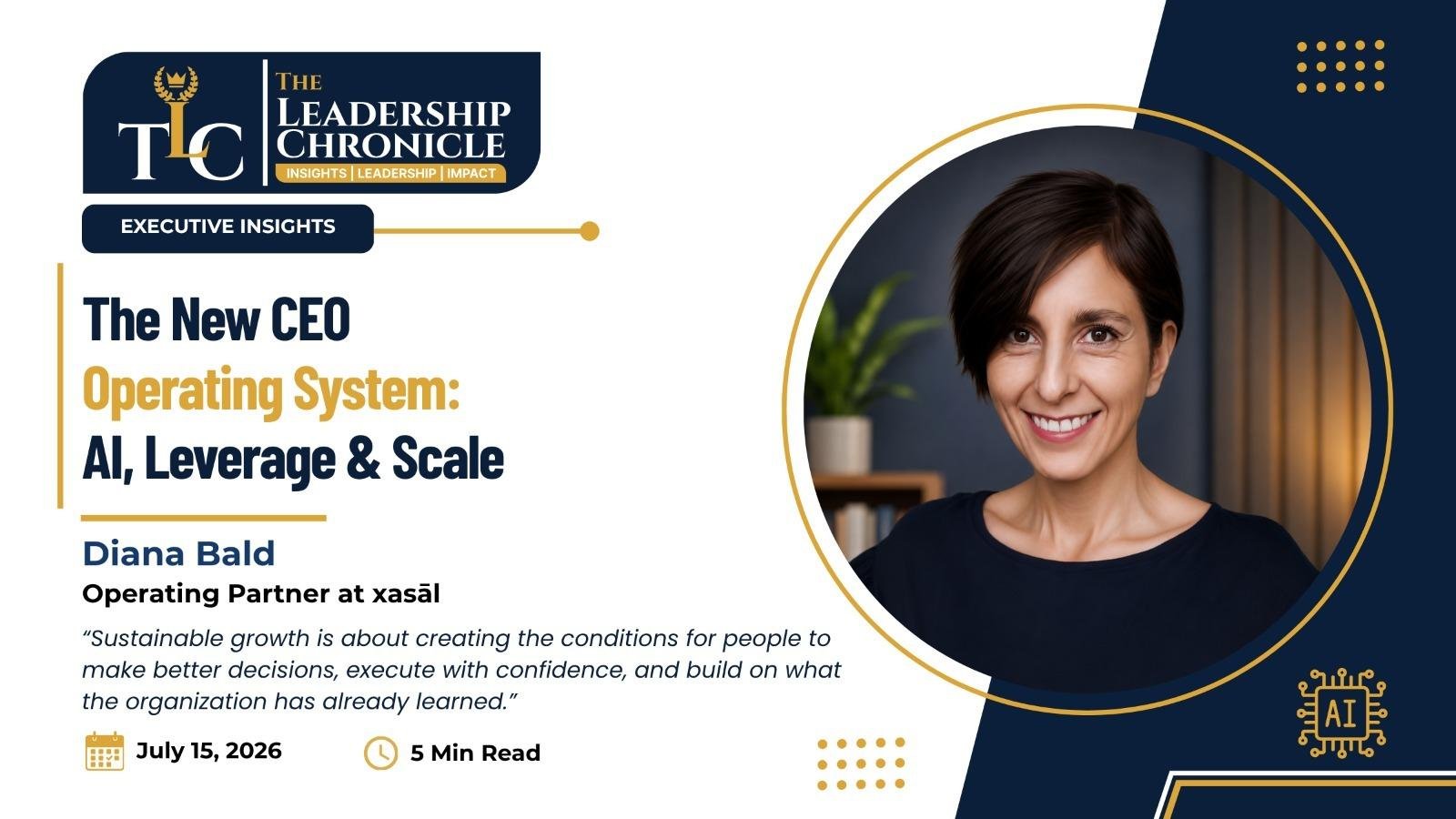
“Sustainable growth is about creating the conditions for people to make better decisions, execute with confidence, and build on what the organization has already learned.”
If there is one lesson I have carried throughout my career, it is that sustainable growth is about creating the conditions for people to make better decisions, execute with confidence, and build on what the organization has already learned.
The economics of scale continue to evolve.
The opportunity for today’s mid-market CEO is to design an operating system where people, processes, and intelligent technologies work together to create enduring value. Organizations built on leverage, learning, and disciplined execution will be well positioned to serve their customers, strengthen their teams, and create lasting enterprise value for years to come.
For more details, visit: https://theleadershipchronicle.com/
If you would like to get featured or want to know more, connect with us at contact@theleadershipchronicle.com
LinkedInn : https://www.linkedin.com/company/the-leadership-chronicle/
Twitter : @TLChronicle


 English
 Arabic
 Français
 Español
 Português
 Deutsch
 Türkçe
 Dutch
Dutch
 Italiano
 Romaian
 Portuguese (Brazil)
 Greek
Greek