


FMCS BIS: Complete Guide to Foreign Manufacturer Certification Scheme
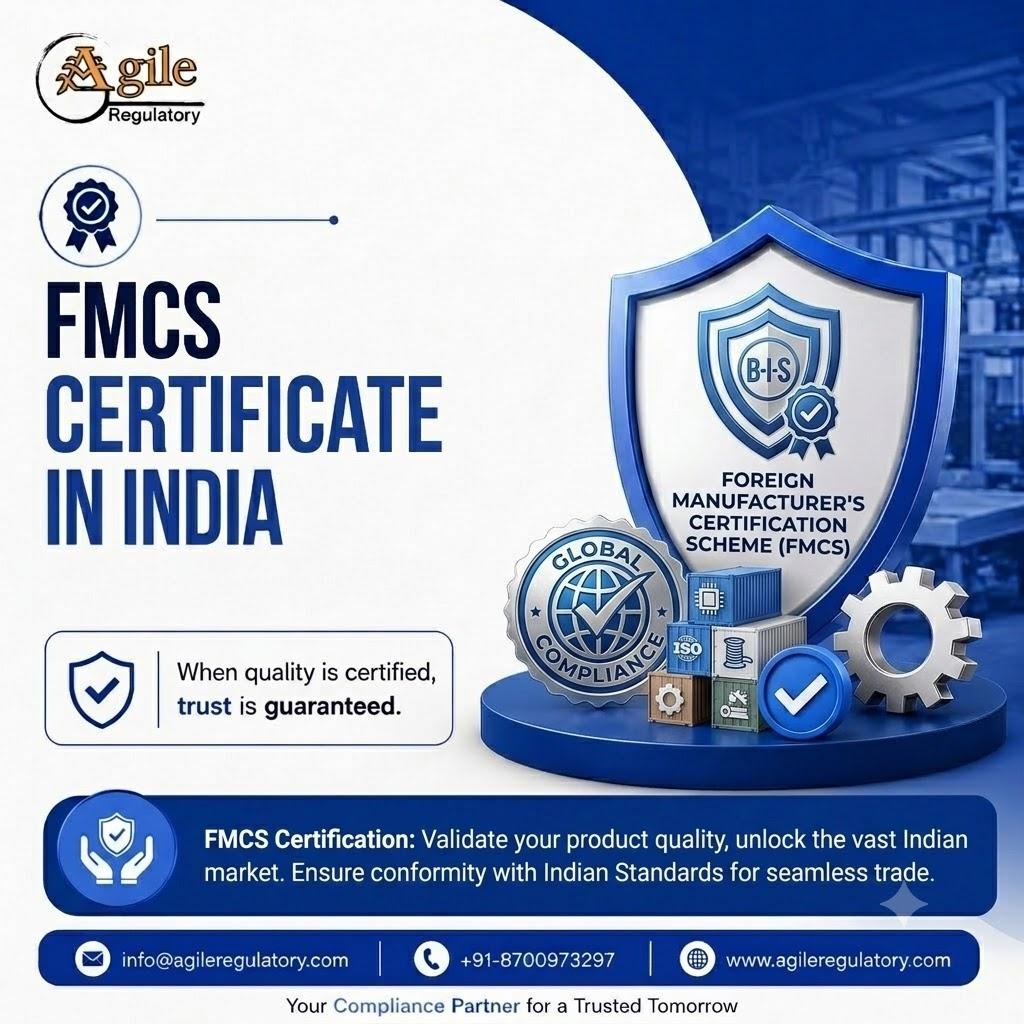
Foreign manufacturers intending to export products to India must comply with the quality standards prescribed by the Bureau of Indian Standards (BIS). For products covered under mandatory certification, overseas manufacturers are required to obtain approval under the Foreign Manufacturers Certification Scheme (FMCS) before their products can be imported or sold in India. The scheme ensures that imported products meet the same safety and quality standards as products manufactured within India. This guide explains the complete FMCS BIS process, eligibility, required documents, registration procedure, and the benefits of certification for foreign manufacturers.
FMCS BIS
What is FMCS BIS?
The Foreign Manufacturers Certification Scheme (FMCS) is a certification scheme operated by the Bureau of Indian Standards for overseas manufacturers intending to export products covered under mandatory BIS certification to India. Under this scheme, eligible foreign manufacturers obtain a BIS licence after demonstrating compliance with the applicable Indian Standards and certification requirements.
Obtaining FMCS BIS approval enables foreign manufacturers to legally supply regulated products in the Indian market while meeting the prescribed quality and safety standards.
The certification process generally includes product evaluation, factory inspection, technical assessment, and licence approval.
Why is FMCS Certification Important?
FMCS certification provides several important advantages for foreign manufacturers.
Regulatory Compliance
Certification ensures compliance with mandatory Indian quality regulations applicable to notified products.
Access to the Indian Market
Approved manufacturers can legally export regulated products to India.
Consumer Confidence
Products manufactured under BIS standards improve customer trust and acceptance.
Better Brand Reputation
Certified products demonstrate commitment to internationally recognized quality standards.
Who Should Apply?
FMCS certification is generally applicable to:
-
Foreign Manufacturers
-
Overseas Brand Owners
-
Exporters to India
-
International Manufacturing Companies
-
Electrical Product Manufacturers
-
Steel Manufacturers
-
Chemical Manufacturers
-
Consumer Goods Manufacturers
The applicable certification requirement depends upon the notified product category.
Eligibility Criteria
Applicants generally require:
-
Manufacturing Facility
-
Product Specifications
-
Factory Quality System
-
Testing Facilities
-
Authorized Indian Representative (where applicable)
-
Compliance with Relevant Indian Standard
Meeting these eligibility conditions helps ensure smooth application processing.
Documents Required
Applicants should prepare the following documents before submitting the application.
Business Documents
-
Company Registration Certificate
-
Manufacturing Licence
-
Factory Address Details
-
Authorization Documents
Product Documents
-
Product Specifications
-
Product Drawings
-
Manufacturing Process Details
-
Product Labels
-
Technical Information
Supporting Documents
-
Product Test Reports
-
Quality Management Documents
-
Identity Proof of Authorized Signatory
-
Trademark Certificate (if applicable)
Preparing complete documentation helps minimize verification delays.
Step-by-Step FMCS BIS Registration Process
Step 1: Product Assessment
Identify whether the product falls under mandatory BIS certification and determine the applicable Indian Standard.
Step 2: Documentation
Prepare all technical documents, manufacturing details, quality records, and supporting business documents.
Step 3: Submit the Application
Submit the prescribed application through the official BIS online system along with the required supporting documents.
Applicants dealing with products covered under the Compulsory Registration Scheme should first determine whether a BIS CRS Certificate is applicable to their product category before selecting the certification pathway.
Step 4: Factory Inspection
BIS officials may inspect the overseas manufacturing facility to verify compliance with the applicable standards and production controls.
Step 5: Technical Evaluation
The Bureau evaluates laboratory reports, technical documents, inspection findings, and product specifications.
Manufacturers covered under the Compulsory Registration Scheme should also understand the requirements for BIS Registration under CRS of MeitY, wherever applicable to their products.
Step 6: Licence Approval
After successful verification, the BIS licence is granted under the Foreign Manufacturers Certification Scheme.
Online Registration and Compliance
Foreign manufacturers can complete Online BIS Registration through the prescribed BIS portal by submitting applications and supporting documents electronically.
Before applying, businesses should understand the Procedure to Get BIS Certification to ensure that all mandatory technical and regulatory requirements are fulfilled.
Applicants should also verify the latest BIS License Cost, as government fees, inspection expenses, laboratory testing charges, and other statutory costs may vary depending on the applicable product category.
Manufacturers often engage experienced BIS License Consultants to coordinate factory inspections, technical documentation, and communication with BIS throughout the certification process.
Products approved under FMCS are permitted to use the official Mark of Bureau of Indian Standards in accordance with the conditions of the licence and the applicable BIS regulations.
Benefits of FMCS BIS Certification
Obtaining FMCS certification offers several long-term advantages.
Legal Market Access
Enables foreign manufacturers to supply regulated products in India.
Strong Regulatory Compliance
Ensures compliance with applicable Indian Standards and Quality Control Orders.
Better Customer Confidence
Certified products are widely accepted by distributors and consumers.
Improved Business Opportunities
Certification supports long-term business expansion in the Indian market.
Competitive Advantage
Compliance strengthens brand reputation and market credibility.
Common Mistakes to Avoid
Applicants should avoid the following mistakes:
-
Selecting the wrong Indian Standard.
-
Submitting incomplete technical documents.
-
Providing outdated laboratory reports.
-
Inadequate factory quality records.
-
Delaying responses to BIS observations.
-
Incorrect product specifications.
Proper planning and complete documentation significantly improve approval efficiency.
Why Choose Agile Regulatory?
Agile Regulatory provides professional consultancy for BIS certifications across India. Our experienced experts assist foreign manufacturers with documentation, technical coordination, factory inspection support, application filing, and complete regulatory compliance.
Apart from BIS certification, Agile Regulatory also offers consultancy for:
-
WPC ETA Approval
-
BEE Registration
-
LMPC Registration
Our team ensures accurate documentation, timely submissions, and hassle-free regulatory approvals for manufacturers entering the Indian market.
Conclusion
Obtaining FMCS BIS certification is an essential requirement for foreign manufacturers supplying regulated products to India. The certification demonstrates compliance with Indian quality standards, facilitates legal market access, enhances customer confidence, and strengthens business credibility. By preparing complete documentation and following the prescribed certification process, overseas manufacturers can reduce approval delays and establish a successful presence in the Indian market. With expert guidance from Agile Regulatory, businesses can complete the FMCS certification process efficiently while ensuring full compliance with BIS regulations.
FAQs
1. What is FMCS BIS?
FMCS (Foreign Manufacturers Certification Scheme) is a BIS certification scheme that allows overseas manufacturers to obtain a BIS licence for products covered under mandatory Indian Standards before exporting them to India.
2. Who should apply under FMCS?
Foreign manufacturers producing products covered under mandatory BIS certification and intending to supply those products to the Indian market should apply under FMCS.
3. Is factory inspection mandatory under FMCS?
Yes. Depending on the applicable certification requirements, BIS may conduct an inspection of the overseas manufacturing facility before granting the licence.
4. What documents are generally required for FMCS certification?
Applicants generally require company registration documents, manufacturing details, product specifications, laboratory reports, quality management records, authorization documents, and supporting technical information.
5. How can Agile Regulatory help?
Agile Regulatory provides end-to-end assistance with FMCS documentation, application filing, factory inspection coordination, BIS certification, and complete regulatory compliance support for foreign manufacturers.


 English
 Arabic
 Français
 Español
 Deutsch
 Türkçe
 Dutch
Dutch
 Italiano
 Russian
 Romaian
 Portuguese (Brazil)
 Greek
Greek