


Most companies I have worked with have a RevOps function long before they have a RevOps operating model. There is a person, or a small team, with the title. They own a dashboard. They fix broken fields in the CRM. They get pulled into the quarterly business review to explain why the pipeline number does not match what sales just said out loud. That is a department. It has a headcount line and a Slack channel. On its own, it is not an operating model, and the gap between the two is where most of the value quietly disappears.
An operating model is a set of rules that governs how commercial decisions get made before they happen. It is not a team that gets called in afterward to explain them. The difference sounds abstract until you watch it play out. Take MEDDICC, the qualification framework built around questions like who the economic buyer is, what the decision criteria actually are, and who inside the account is championing the deal. In plenty of organizations, MEDDICC lives as a set of talking points. A rep is told to think about it, occasionally quizzed on it in a pipeline review, and rarely required to prove it. Once you gate the CRM so a deal genuinely cannot move from qualification to proposal without a real answer on economic buyer or decision criteria, the framework stops being advice and becomes a rule the pipeline itself enforces. The system now carries the discipline that used to live inside a sales manager’s memory, and unlike that manager, it does not walk out the door when someone takes a new job.
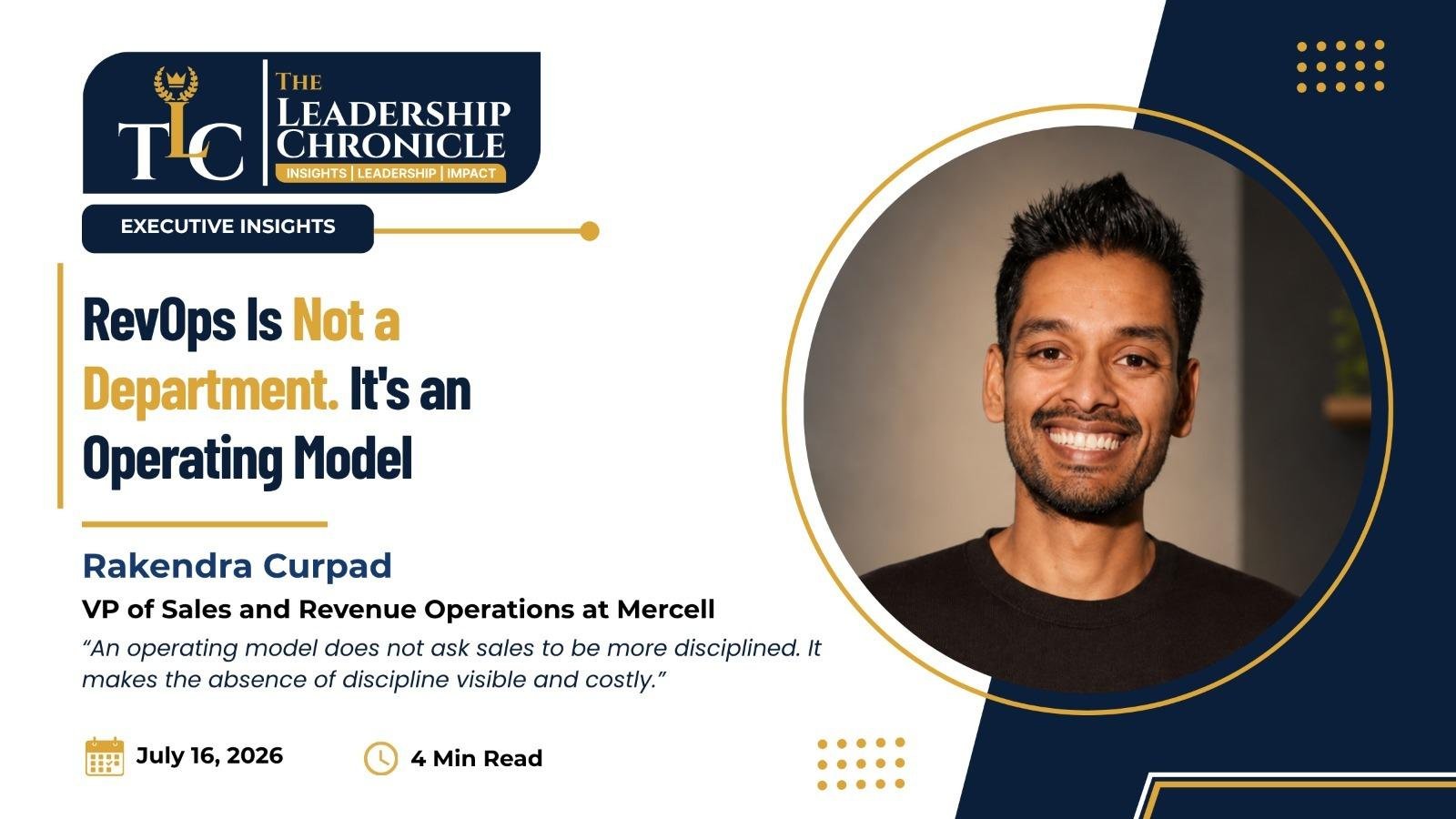
That is the operating model version of RevOps. It does not ask sales to be more disciplined. It makes the absence of discipline visible and costly inside the tool people already use every day.
“An operating model does not ask sales to be more disciplined. It makes the absence of discipline visible and costly.”
Governing the calendar, not just the dashboard
The same logic applies outside the CRM. Picture a marketing team launching a campaign, a billing system nobody checked for readiness, and a compliance review everyone assumed someone else had handled. That is how most campaigns actually fail, quietly, when three teams each did their own job correctly and nobody checked how the pieces fit together. A useful fix is a governance framework with a strict countdown to launch, backed by a short list of mandatory checkpoints: CRM readiness, billing readiness, data quality, lead routing, and compliance. None of those checkpoints belong to RevOps alone. Marketing owns the campaign. Legal owns compliance. Finance owns the billing tooling. What RevOps owns is the sequencing, the rule that none of those functions gets to launch in isolation and discover weeks later that the routing logic sent every enterprise lead to a junior rep who was never equipped to handle it.
“An operating model rarely announces itself with a grand strategic memo. Most days, it looks like a checklist nobody is allowed to skip.”
Going where the org chart says you should not
Sometimes acting like an operating model means walking into territory that is not formally yours. Take discounting. In most companies, a rep can offer a modest discount without asking anyone, and a regional leader can approve something larger with barely a second look. On paper, each individual approval looks perfectly reasonable. In aggregate, nobody actually owns the pattern, and margin quietly erodes deal by deal until Finance notices the average selling price sliding and cannot explain why. A simple discount governance workflow, built directly into the deal record, closes that gap. Discounts above a defined threshold trigger an approval step that routes automatically to the right leader, and the deal cannot move forward until that approval exists. No spreadsheet, no email chain, no relying on someone remembering the rule under quarter-end pressure. Sales still owns the negotiation. Finance still owns the margin target. What RevOps owns is the moment where those two priorities collide, making sure that moment cannot be skipped by accident.
I have seen the opposite failure plenty of times too, scaling operations inside fast-growing companies earlier in my career. RevOps as a department shows up, tidies its own house, produces better reports and a cleaner forecast deck, and calls it a win, while the real friction between functions never gets touched because touching it was never written into anyone’s job description. RevOps as an operating model treats that job description as a starting point, not a fence around what you are allowed to fix.
“Sales still owns the negotiation. Finance still owns the margin target. What RevOps owns is the moment those two priorities collide.”
The test that actually matters
If you want to know which version of RevOps you are running, forget the org chart and ask one question. Is RevOps in the room when a commercial decision is being made, or only in the room afterward, explaining what happened? A department gets summoned to interpret results. An operating model sets the terms under which those results get produced in the first place: the stage gates, the sequencing rules, the definitions everyone agreed to before the argument ever started.
None of this requires new headcount or a rebrand. It asks leaders to treat RevOps less like a support function and more like the rulebook the rest of the business is already playing by, whether anyone bothered to write it down or not. The best leaders I know did not wait for permission to build that rulebook. They started writing it, one gate and one definition at a time, until the business ran on it without noticing. That is the real opportunity in front of every CXO, founder, and VP reading this: the companies that pull ahead over the next decade will not be the ones with the fanciest dashboards. They will be the ones where nobody can remember the last time a launch, a discount, or a deal fell through a crack that everyone could see coming.
For more details, visit: https://theleadershipchronicle.com/
If you would like to get featured or want to know more, connect with us at contact@theleadershipchronicle.com
LinkedInn : https://www.linkedin.com/company/the-leadership-chronicle/
Twitter : @TLChronicle


 English
 Arabic
 Français
 Español
 Português
 Deutsch
 Türkçe
 Italiano
 Russian
 Romaian
 Portuguese (Brazil)
 Greek
Greek