


How Do AI-Driven Signals Make an HFT Trading Bot Smarter Than Rule-Based Systems?
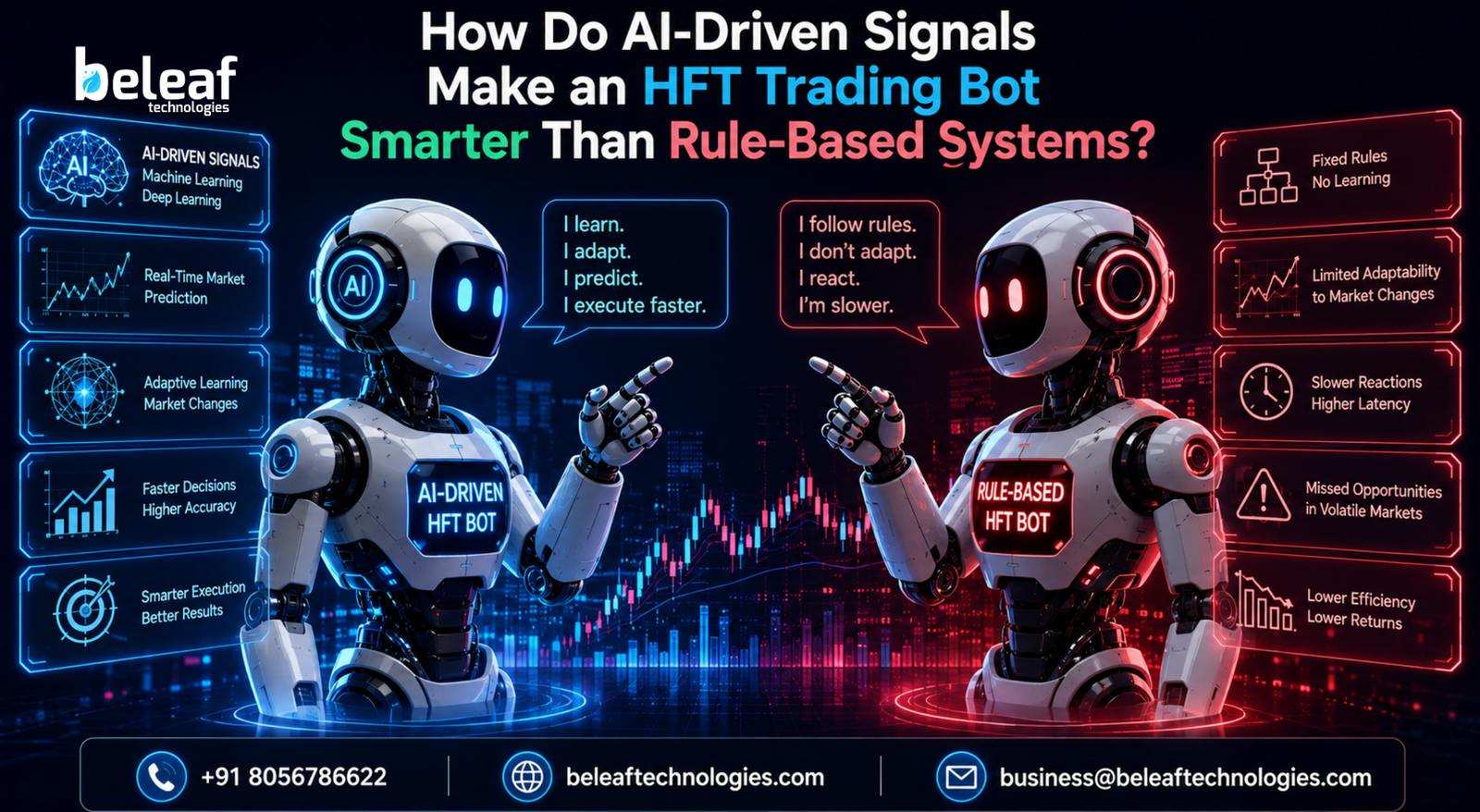
Ask any old-school trader what separated the winners from the rest a decade ago, and they'll probably say speed. Fastest connection, fastest execution, done. That story doesn't hold up anymore. An HFT trading bot running on fixed rules can be lightning fast and still lose to a slower system that simply understands the market better. Speed gets you to the door. Intelligence decides whether you should walk through it.
What A Rule-Based Bot Actually Does
Strip away the jargon and a rule-based bot is just a checklist. Price crosses this line, buy. Volume drops below that number, sell. Nothing fancy, and honestly, that simplicity used to be a strength. In steady markets, a checklist trader never panics, never second-guesses, never gets tired.
The problem shows up the moment the market stops behaving. A surprise headline, a liquidity air pocket, a sudden burst of volatility, none of that registers with a checklist. The bot just keeps ticking boxes on rules written for a market that no longer exists. Someone has to catch the mismatch, sit down, and rewrite the logic by hand. Meanwhile, the bot has already lost money running on outdated assumptions.
Where AI-Driven Signals Actually Help
An AI-driven HFT trading bot isn't reading from a checklist, it's reading the room. It pulls in order book activity, momentum, how correlated assets are behaving, shifts in liquidity, and volatility patterns, then blends all of it into one live picture of what's happening right now. As new data rolls in, that picture updates. There's no waiting for a developer to notice something's off.
A decent way to picture it: one driver follows a printed map no matter what's happening on the road. The other checks live traffic and reroutes before hitting the jam. Both know the destination. Only one of them actually gets there on time.
Spotting Patterns A Fixed Rule Would Never Catch
Markets throw off a lot of noise, and most of it means nothing. Separating real signal from random fluctuation is genuinely hard, and it's exactly where trained models pull ahead of hardcoded rules. A fixed rule sees a spike and reacts. A trained model asks whether that spike actually matches a pattern worth trading on.
There's also the cross-asset angle. Two stocks with no obvious connection can start moving in sync during certain conditions, maybe a shared supplier, a sector rotation, whatever the cause. A model trained on enough history picks up on that link early. A static rule set never sees it coming.
Risk Doesn't Get Ignored Either
Making money is only half the job, protecting it is the other half. AI-driven signals keep watch on volatility spikes, thinning liquidity, and unusual order flow at the same time, and they respond accordingly, smaller positions, skipped trades, or a full pause when things look shaky. Building that kind of judgment into a fixed rule is nearly impossible; you'd need a rule for every possible bad scenario, and markets always find a new one.
It's Not Magic, Though
AI-driven bots aren't automatically better just because they're AI-driven. Feed one bad data or skip proper testing, and it'll make confidently wrong decisions just as fast as a broken rule would. The advantage only shows up when the system is trained well and watched closely.
Bottom Line
Markets keep changing shape, and a bot stuck on fixed rules simply can't keep up. An HFT trading bot built around AI-driven signals adjusts as conditions shift, catching what static logic misses. The real edge was never pure speed. It's judgment, applied fast enough to matter.
Explore the Benefits >>
https://www.beleaftechnologies.com/hft-trading-bot-development
WhatsApp : +91 8056786622
Reach us : https://www.beleaftechnologies.com/contact-us


 English
 Arabic
 Français
 Español
 Português
 Deutsch
 Türkçe
 Dutch
Dutch
 Italiano
 Romaian
 Portuguese (Brazil)
 Greek
Greek