


The Infrastructure Challenges Behind Real-World Asset Tokenization
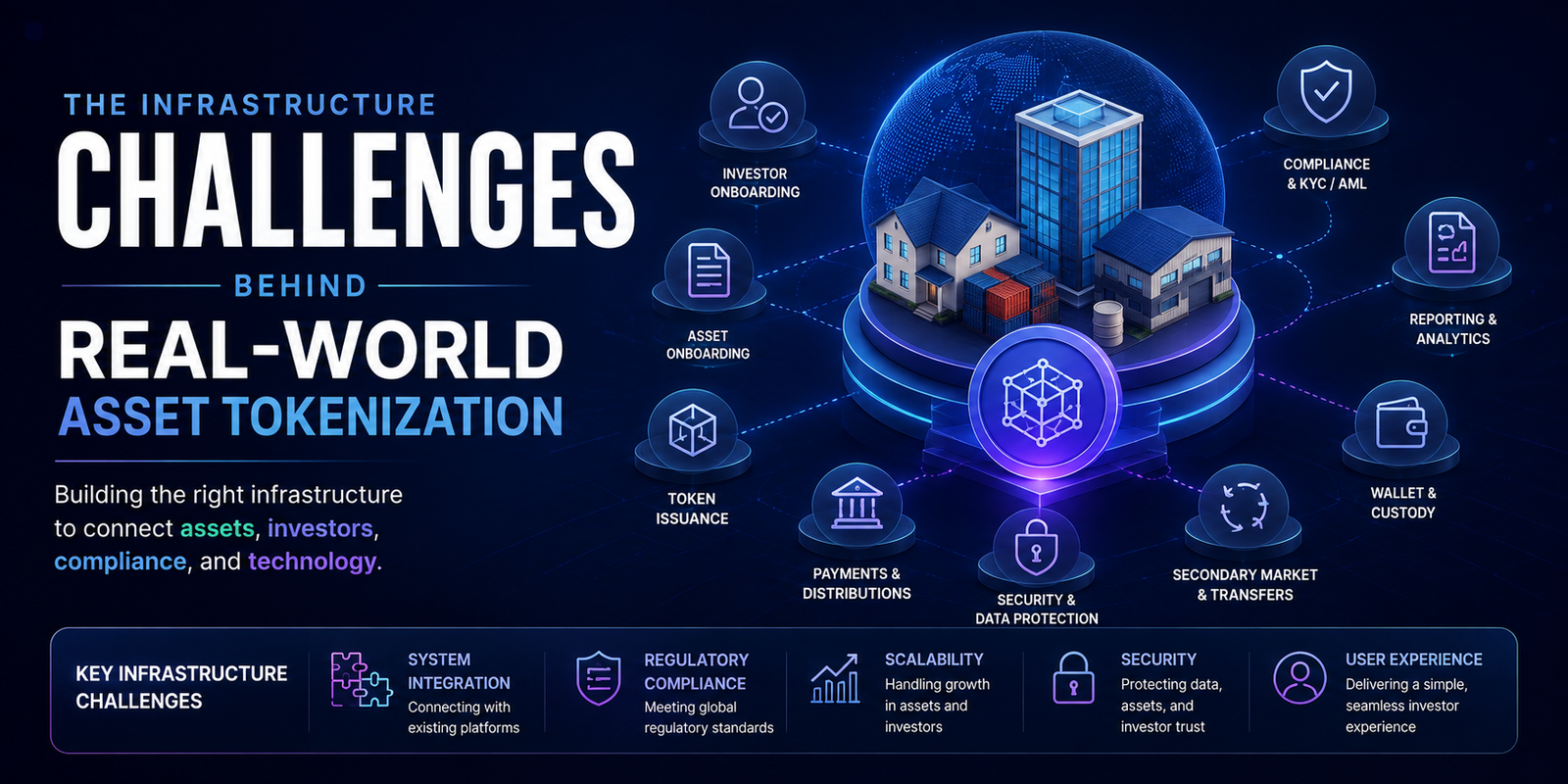
Real-world asset tokenization is gaining attention across real estate, private credit, private equity, commodities, and other asset classes. The concept is relatively straightforward: represent ownership or economic interests in an asset through blockchain-based tokens.
However, turning that concept into a functional business platform is much more complex.
The biggest challenge is often not creating the token itself. It is building the infrastructure around the token.
Tokenization Goes Beyond Smart Contracts
A smart contract can define how tokens are issued, transferred, or managed, but a complete tokenization platform needs to support the entire asset lifecycle.
Businesses may need infrastructure for:
- Asset onboarding
- Token issuance
- Investor registration
- KYC and AML verification
- Wallet management
- Payments and distributions
- Ownership records
- Compliance controls
- Reporting and analytics
- Token transfers
- Secondary-market functionality
Without these components, businesses can end up with a token but no efficient way to operate the underlying investment ecosystem.
Challenge 1: Connecting Existing Systems
Most businesses already use CRM platforms, accounting software, payment systems, investor-management tools, and asset-management solutions.
Introducing tokenization creates another technology layer that needs to communicate with these systems.
For example, investor information may need to move between the company's existing CRM and tokenization platform. Transaction data may need to connect with accounting systems, while distribution information may need to flow into reporting tools.
API-based integration can help create a connected environment without forcing businesses to replace systems that already work.
Challenge 2: Managing Compliance
Tokenized assets can involve significant regulatory considerations depending on the asset, jurisdiction, structure, and investor type.
A platform may need to support investor eligibility, KYC/AML checks, transfer restrictions, transaction monitoring, and compliance reporting.
These requirements should be considered during platform architecture rather than added as an afterthought.
Embedding appropriate compliance workflows into the platform can help businesses manage regulatory requirements more consistently.
Challenge 3: Supporting the Complete Asset Lifecycle
Tokenization does not end when tokens are issued.
A real-world asset may need to go through several stages:
Asset Onboarding → Token Issuance → Investor Participation → Ownership Management → Distributions → Reporting → Transfers
The infrastructure needs to support these processes throughout the asset's lifecycle.
This becomes particularly important when a business manages multiple assets, investor groups, or token structures.
Challenge 4: Building for Scale
A platform designed for one asset may not automatically be suitable for hundreds of assets and thousands of investors.
Businesses need to consider scalability from the beginning.
Important factors include:
- Platform performance
- Blockchain compatibility
- Database architecture
- Smart contract management
- Investor management
- Transaction processing
- Security
- Reporting infrastructure
Choosing technology that can expand alongside the business can prevent expensive redevelopment later.
Challenge 5: Creating a Simple Investor Experience
Blockchain technology can be complex behind the scenes, but investors do not necessarily need to interact with that complexity.
A well-designed platform should make processes such as registration, verification, investment, portfolio tracking, and reporting straightforward.
The user experience should feel like a modern financial platform rather than a technical blockchain application.
Build Everything or Use Existing Infrastructure?
Businesses entering tokenization must also decide how much infrastructure to develop internally.
Building everything from scratch can provide greater control but may require significant development resources, blockchain expertise, security capabilities, and ongoing maintenance.
Working with a white label tokenization platform development service provider can offer another approach, allowing businesses to use established infrastructure while customizing the platform around their brand and requirements.
Conclusion
Real-world asset tokenization is not simply a blockchain development project. It is an infrastructure challenge involving technology, compliance, integrations, operations, investors, and asset management.
Businesses that plan for these requirements from the beginning can create a stronger foundation for launching and scaling tokenized assets.
The goal should not simply be to create a token, but to build an infrastructure ecosystem capable of managing that token throughout its entire lifecycle.


 English
 Arabic
 Français
 Español
 Português
 Deutsch
 Dutch
Dutch
 Italiano
 Russian
 Romaian
 Portuguese (Brazil)
 Greek
Greek