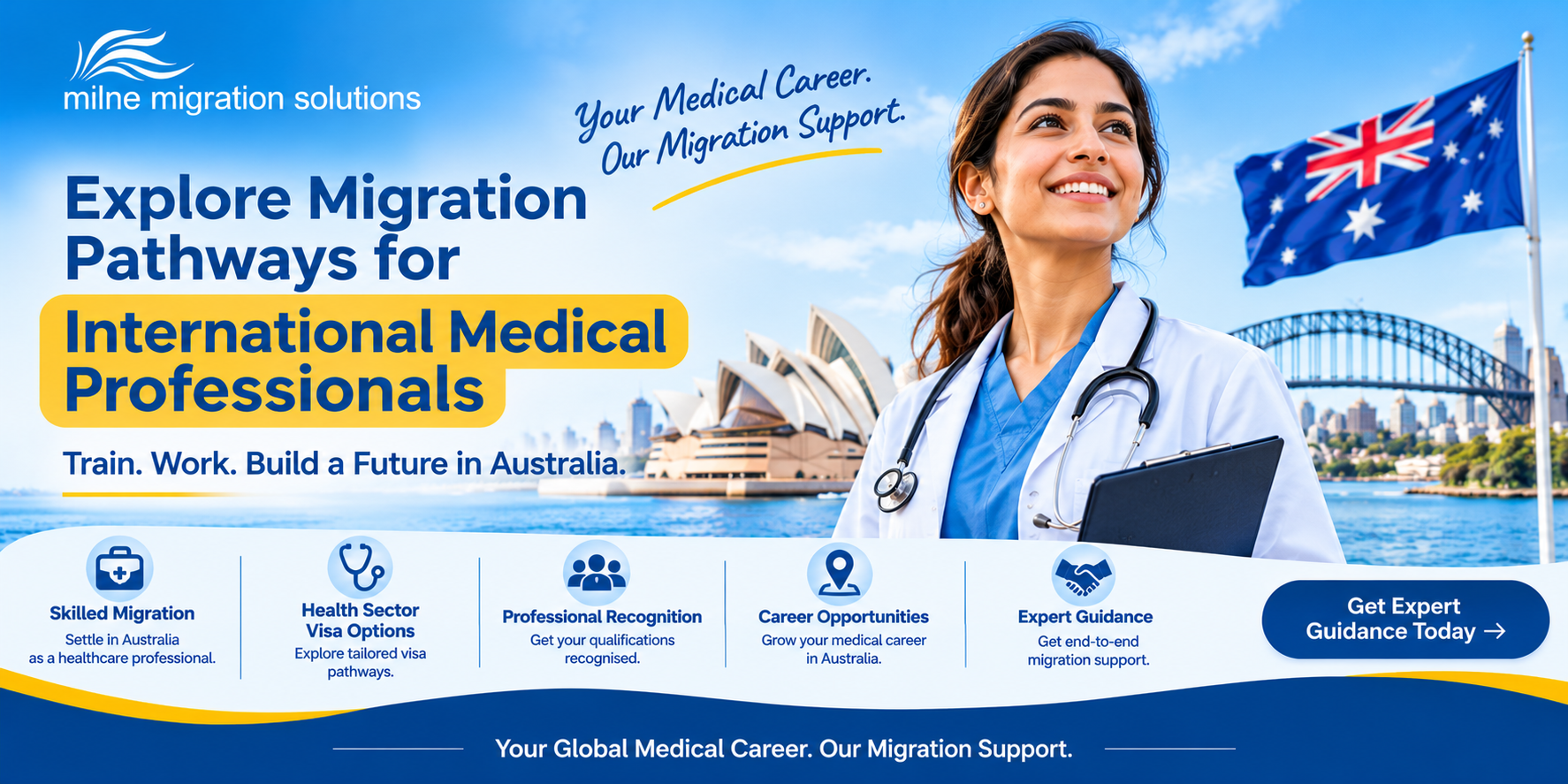
Your Healthcare Career in Australia: Explore Migration Pathways for International Medical Professionals

Australia continues to attract healthcare professionals from around the world who want to develop their careers in a modern healthcare system. With opportunities across hospitals, community health services, regional facilities and private practices, the country can offer an appealing destination for qualified doctors and other medical practitioners.
However, moving to Australia to work in healthcare involves more than securing employment. International applicants must understand professional registration, qualification recognition, visa eligibility and relevant employment requirements before making the move.
Whether you are a doctor, specialist or allied health professional, understanding the available pathways is an important first step. This guide explains key considerations for Healthcare Professionals Migration Australia, including visa options, registration requirements and the support available during the migration process.
Why Consider a Healthcare Career in Australia?
Australia has a diverse healthcare sector, with employment opportunities across metropolitan and regional communities. Internationally qualified professionals may explore positions in:
-
Public and private hospitals
-
General medical practices
-
Specialist clinics
-
Regional and rural healthcare facilities
-
Rehabilitation and community health services
-
Allied health organisations
Your opportunities will depend on your qualifications, professional experience, registration eligibility and the requirements of individual employers.
Regional locations may also provide opportunities for professionals interested in working outside major cities. However, applicants should evaluate the role, location, registration requirements and applicable visa conditions before accepting an offer.
Understanding Visas for Healthcare Professionals
Choosing the correct immigration pathway depends on your occupation, qualifications, employment arrangements and long-term plans. Several Australian visa categories may be relevant to eligible healthcare workers.
1. Skills in Demand Visa (Subclass 482)
The Skills in Demand visa (subclass 482) may be suitable for healthcare professionals who have an eligible occupation and an Australian employer willing to sponsor them.
Depending on the relevant stream and requirements, applicants may need to demonstrate:
-
Relevant qualifications and professional experience
-
An eligible nominated occupation
-
Required English-language proficiency
-
Relevant skills or registration
-
Compliance with visa criteria
The sponsoring employer must also meet applicable sponsorship and nomination obligations.
2. Employer Nomination Scheme Visa (Subclass 186)
The Employer Nomination Scheme visa (subclass 186) is a permanent residence pathway for eligible skilled workers nominated by an Australian employer.
Depending on the stream, applicants may need to meet requirements relating to age, qualifications, work experience, skills assessment and professional registration. Eligibility and exemptions differ between streams.
Healthcare professionals considering this option should assess their circumstances carefully before proceeding.
3. Skilled Nominated Visa (Subclass 190)
The Skilled Nominated visa (subclass 190) is a points-tested permanent visa for eligible skilled workers nominated by an Australian state or territory.
Applicants generally need to meet the relevant occupation, skills assessment, points and nomination requirements. State and territory programs may have additional occupation-specific criteria and selection priorities.
4. Skilled Work Regional Visa (Subclass 491)
The Skilled Work Regional (Provisional) visa (subclass 491) provides a pathway for eligible skilled workers to live and work in designated regional areas.
This option may interest healthcare professionals willing to consider regional employment. Applicants must satisfy the relevant nomination or family sponsorship requirements, occupation criteria and other visa conditions.
The availability of particular occupations and nomination opportunities can change, so applicants should check current requirements before preparing an application.
Doctors Migration to Australia: What International Doctors Need to Know
The process of Doctors Migration to Australia involves two important areas: professional registration and immigration approval. These are separate processes, and satisfying one does not automatically guarantee approval of the other.
International medical graduates should understand the requirements of the Medical Board of Australia and the Australian Medical Council (AMC).
Medical Qualification Recognition
Doctors must establish whether their primary medical qualification is recognised for the relevant Australian registration pathway.
Qualification verification, assessment requirements and supporting documents depend on the applicant's education, country of training and professional background.
Medical Registration Pathways
International medical graduates may be assessed through different pathways, depending on their qualifications and experience.
Competent Authority Pathway: This pathway may apply to eligible doctors who have completed recognised training or assessment processes in specified competent authority jurisdictions.
Standard Pathway: This pathway generally applies to international medical graduates who do not qualify for the competent authority or specialist pathways. It involves assessment requirements established by the AMC and Medical Board.
Specialist Pathway: This pathway is relevant to doctors with specialist qualifications seeking recognition as specialists in Australia. Assessment may involve the relevant specialist medical college.
Doctors should confirm which pathway applies to their individual circumstances before making employment or migration decisions.
English Language and Professional Requirements
Applicants must satisfy the applicable English-language registration standard and other professional requirements. Depending on the pathway, further examinations, supervised practice or additional training may be necessary.
The Medical Board of Australia determines registration eligibility. Doctors cannot assume that overseas registration automatically allows them to practise in Australia.
Australia Doctors Immigration: Planning Beyond Registration
Australia Doctors Immigration requires careful coordination between professional registration, employment and visa applications.
A doctor may have suitable qualifications but still need to complete additional registration steps or secure an appropriate employment arrangement.
Before proceeding, consider:
-
Whether your medical qualification is recognised.
-
Which registration pathway applies to your background.
-
Whether you need additional assessment or supervised practice.
-
Whether you have an eligible employment opportunity.
-
Which visa category matches your circumstances.
-
Whether you meet the relevant immigration and professional requirements.
Planning these steps early can help reduce avoidable delays and documentation problems.
Migration Options for Other Healthcare Professionals
Australia also has opportunities for eligible healthcare workers outside the medical profession. Depending on the occupation, professionals such as physiotherapists, occupational therapists, radiographers and other allied health practitioners may explore skilled or employer-sponsored migration pathways.
However, each profession has its own qualification assessment, registration and licensing requirements.
For regulated professions, applicants should identify the relevant Australian registration board and accreditation authority. Some occupations also require a formal skills assessment for particular visa categories.
How Professional Migration Assistance Can Help
Navigating professional registration and immigration requirements can be challenging, particularly when several organisations are involved.
Experienced migration professionals can help applicants understand the immigration side of the process by:
-
Reviewing personal circumstances and potential visa pathways
-
Explaining relevant visa eligibility requirements
-
Identifying documentation requirements
-
Assisting with application preparation
-
Providing guidance on employer-sponsored applications
-
Explaining nomination and sponsorship procedures
-
Helping applicants understand visa conditions
Professional migration assistance does not replace registration or qualification assessments conducted by the relevant Australian authorities. Instead, it can help applicants manage the immigration process with a clearer understanding of their responsibilities.
Begin Your Australian Healthcare Migration Journey
Building a healthcare career in Australia can be an important professional milestone, but successful planning requires attention to both immigration and professional requirements.
From understanding Visas for Healthcare Professionals to exploring Doctors Migration to Australia, applicants should take time to identify the appropriate pathway for their qualifications, experience and career goals.
Milne Migration can help you understand relevant migration options and prepare for the next stage of your journey. Visit the Healthcare Professionals page to explore professional migration assistance.
Plan carefully, understand your eligibility and take an informed step towards your future in Australia's healthcare sector.
Disclaimer: This article provides general information and does not constitute legal or migration advice. Visa criteria, occupation lists, registration standards and application procedures may change. Always consult the Department of Home Affairs and the relevant Australian professional registration authority for current requirements.