

How Data Analysts and Data Scientists Help Businesses Overcome Challenges

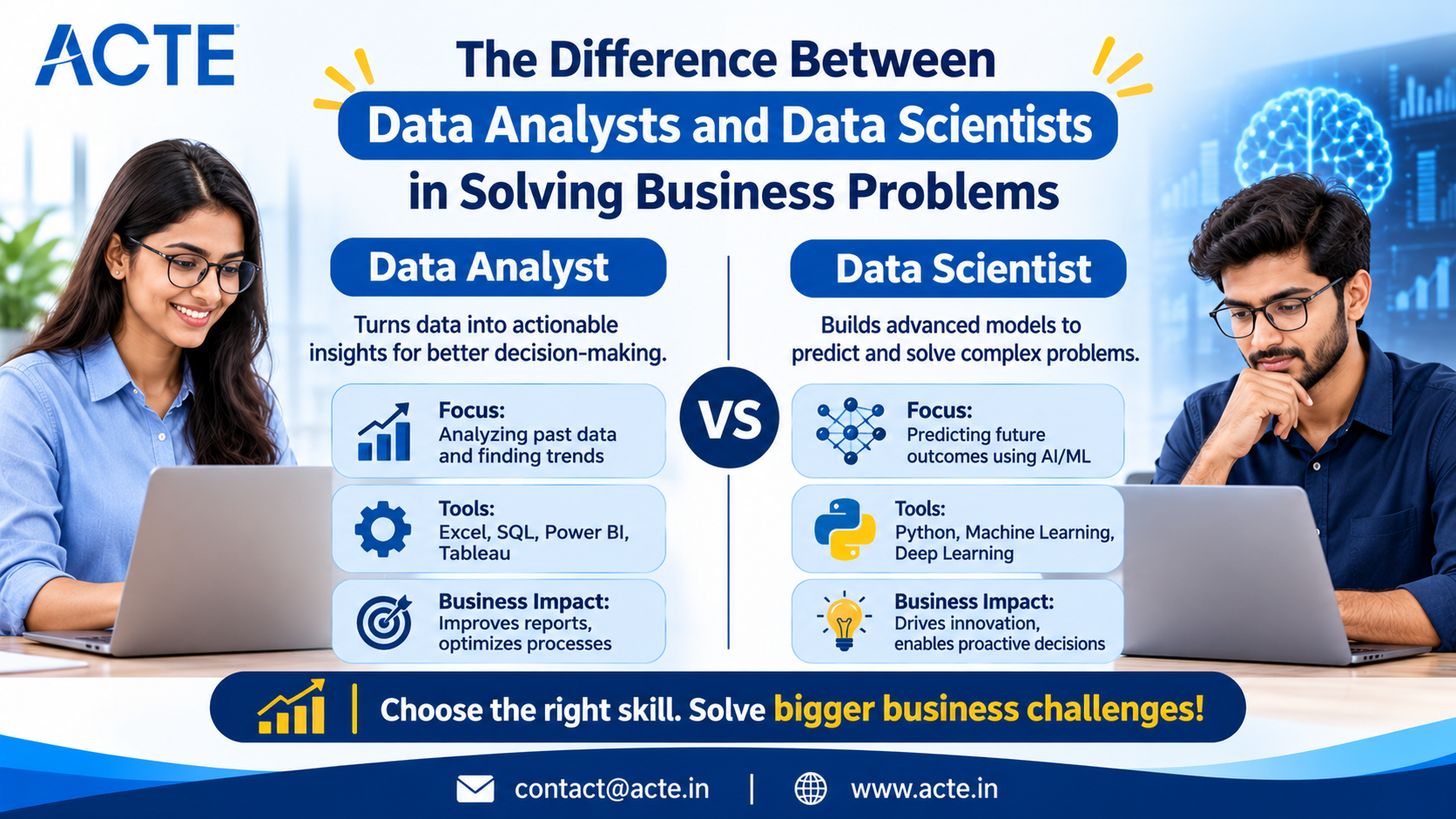
Data-driven decision-making has become an important part of modern business strategy. Organizations use data to understand customer expectations, evaluate operational performance, identify risks, and discover opportunities for growth. Data analysts and data scientists support these goals through different methods of investigation and problem-solving. Data analysts interpret existing information to explain trends and recommend improvements, while data scientists use programming, statistical techniques, and machine learning to predict outcomes and develop advanced analytical solutions. Understanding these roles helps aspiring professionals identify suitable career opportunities. Enrolling in Data Science Course Training can help learners establish a strong foundation in data technologies and their practical business applications.
How Data Analysts Identify Business Trends and Performance Issues
Data analysts help businesses understand what their information reveals about daily operations and long-term performance. They collect data from databases, spreadsheets, customer platforms, and business applications before cleaning and organizing it for analysis. Their work may involve evaluating sales performance, monitoring customer satisfaction, comparing marketing campaigns, and identifying operational inefficiencies. For example, an analyst in a retail company might examine regional sales figures to determine why certain products are generating fewer purchases. SQL, Excel, Python, Power BI, and Tableau are commonly used to process data and communicate findings. By presenting information through reports and dashboards, analysts help managers recognize problems and make evidence-based decisions.
How Data Scientists Build Solutions for Complex Business Problems
Data scientists use advanced analytical methods to investigate complicated challenges and estimate future business outcomes. Their work combines programming, mathematics, statistics, and machine learning to identify patterns and develop predictive models. For instance, an insurance company may use data science to estimate potential claim risks, while an e-commerce business may build recommendation systems based on customer preferences. Data scientists also test their models, evaluate prediction quality, and improve algorithms as new data becomes available. Their solutions can help organizations automate selected processes, improve forecasting, and support strategic planning. Professionals interested in these capabilities can explore Data Science Training in Bangalore to learn about predictive analytics, machine learning, and related technical concepts.
Understanding the Differences Between Their Responsibilities
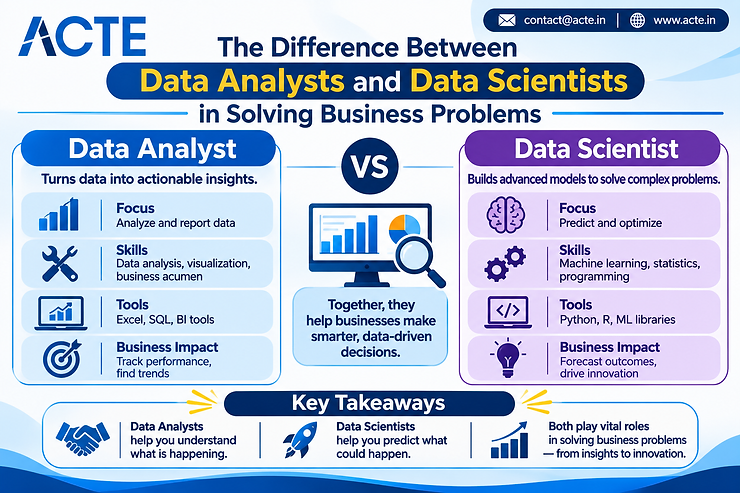
Although data analysts and data scientists both work with datasets, their responsibilities often focus on different questions. Data analysts generally investigate what happened, why a business result changed, and which factors contributed to that outcome. Data scientists frequently examine what might happen next and how predictive models can support future decisions. For example, an analyst may identify reasons for declining customer engagement, while a data scientist may create a model to estimate which customers are likely to discontinue a service. Analysts commonly deliver reports, dashboards, and recommendations, whereas data scientists may develop forecasting models and machine learning systems. However, the distinction varies by organization, and both professionals may collaborate throughout a project.
Important Tools and Skills for Data Analytics and Data Science
Data analysts typically use SQL for data extraction, Excel for calculations, and Power BI or Tableau to create visual reports. They may also use Python and statistical methods to investigate more complex questions. Data scientists generally require additional knowledge of programming, probability, mathematical modeling, and machine learning libraries. Both roles demand accurate data preparation, critical thinking, problem-solving, and the ability to explain findings clearly. Business knowledge is equally valuable because technical analysis must address real organizational requirements. Learning through Data Science Training in Chennai can help aspiring professionals understand these technologies and explore how analytical techniques are applied to practical business challenges.
Applying Data-Driven Methods Across Different Industries
Organizations in retail, healthcare, finance, manufacturing, logistics, and education use data analytics and data science to improve performance. Retail analysts study product sales and customer purchasing habits, while data scientists develop demand forecasting and recommendation models. In banking, analysts examine financial reports and transaction trends, whereas data scientists can develop models that support fraud detection and risk assessment. Healthcare providers use analysts to evaluate service efficiency and resource utilization, while data science techniques can help forecast demand and support research. Manufacturers analyze production records to locate bottlenecks and may use predictive models to anticipate equipment failures. These complementary approaches help businesses improve resource allocation, manage uncertainty, and make more informed operational decisions.
Selecting a Career Path That Matches Your Strengths
Choosing between data analytics and data science depends on personal interests, existing knowledge, and career goals. Data analytics may suit individuals who enjoy working with business reports, spreadsheets, dashboards, and performance indicators. Data science may appeal to people who prefer programming, mathematics, experimentation, and predictive modeling. Beginners can start by developing skills in SQL, Excel, Python, and statistics before exploring advanced topics. Practical projects such as sales dashboards, customer segmentation, churn prediction, and demand forecasting provide opportunities to apply theoretical knowledge. Learners who want to develop their technical foundation can explore Data Science Training in Hyderabad and strengthen their understanding of data-driven problem-solving.
Career Development and Future Opportunities in Data Technology
Both professions offer opportunities for growth as businesses increasingly adopt automation, artificial intelligence, and advanced analytics. Data analysts may progress into senior analyst, business intelligence, analytics consulting, or reporting management roles. Developing additional programming and statistical skills may open opportunities in more advanced analytical positions. Data scientists can pursue careers in machine learning engineering, predictive analytics, applied research, and technical leadership. Progression depends on practical experience, specialized knowledge, communication abilities, and the capacity to solve business problems effectively. Since data technologies continue to evolve, professionals benefit from regularly updating their skills and learning new analytical approaches. Combining technical expertise with business understanding can help them contribute to organizational innovation and long-term success.
Conclusion:
Data analysts and data scientists help organizations address business challenges through complementary approaches. Analysts examine existing information to identify trends, explain performance, and recommend improvements, while data scientists apply advanced statistical methods and machine learning to forecast outcomes and develop predictive solutions. Understanding their differences helps learners choose a career that aligns with their interests and technical abilities. Building practical skills, completing relevant projects, and understanding business requirements can prepare aspiring professionals for opportunities in the expanding data industry.


