

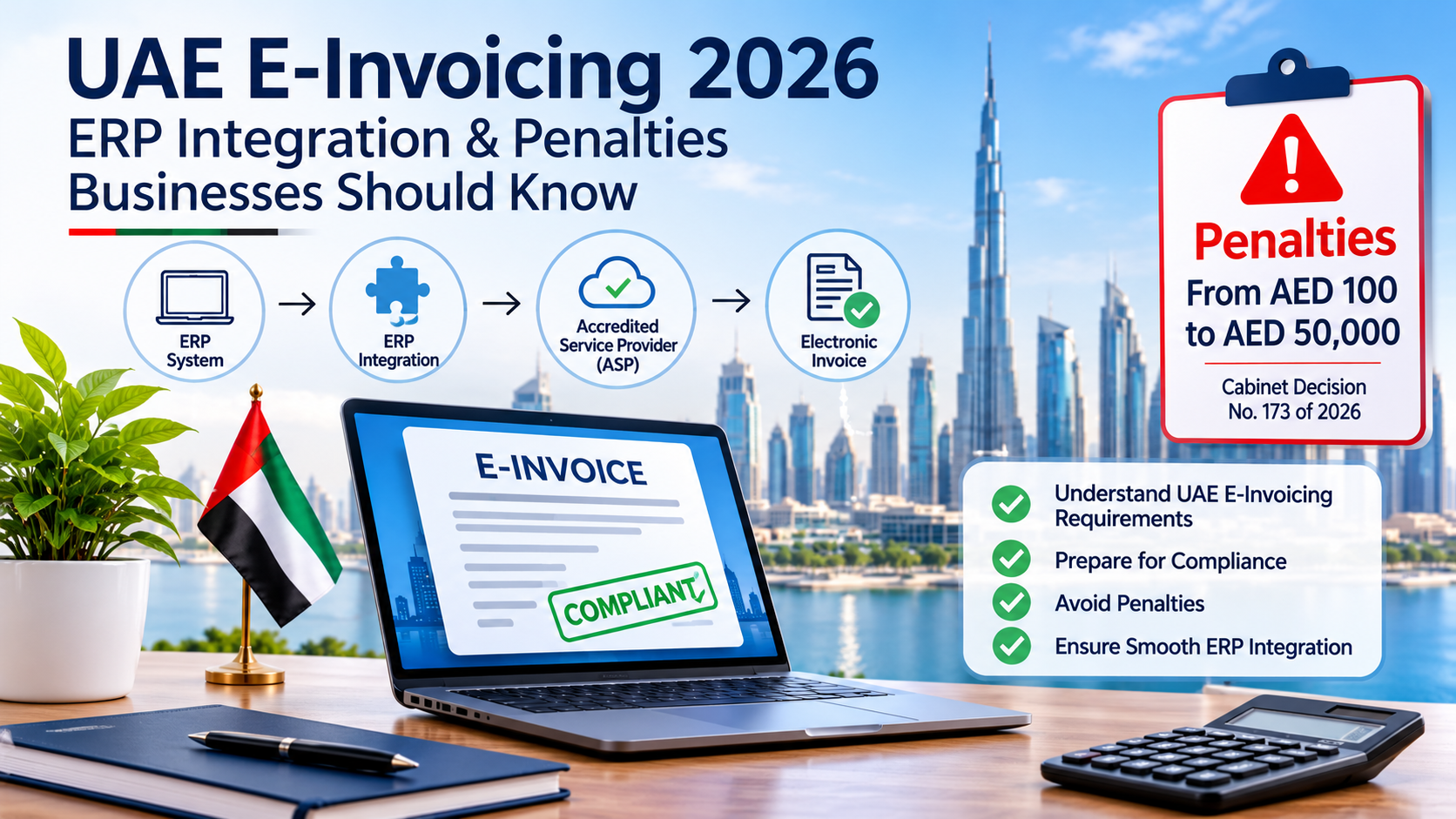
UAE ERP Integration and E-Invoicing Penalties: What Businesses Need to Know in 2026

The UAE is moving towards a structured electronic invoicing system to improve tax compliance, transparency, and digital business operations. For companies using ERP software, this transition means preparing their systems to exchange invoice data electronically and comply with UAE e-invoicing requirements. Understanding UAE ERP integration and UAE E-Invoicing Penalties is becoming increasingly important for businesses that want to avoid compliance issues and maintain smooth operations.
What Is UAE E-Invoicing in 2026?
E invoicing UAE 2026 refers to the UAE's transition towards electronic invoices exchanged through a structured digital format rather than traditional paper invoices or PDF documents alone. The system is designed to support automated invoice processing, reporting, and tax compliance.
Businesses will need to prepare their accounting, billing, and ERP systems to handle electronic invoices according to the applicable implementation timelines and regulatory requirements.
The UAE e-invoicing requirements include structured invoice data, integration with approved service providers, accurate tax information, and the ability to electronically exchange invoice records. Businesses should review their current systems to ensure they are ready for the transition.
What Are UAE E-Invoicing Penalties Under Cabinet Decision No. 173 of 2026?
UAE E-Invoicing Penalties are administrative fines imposed on businesses that fail to follow the applicable electronic invoicing rules. Cabinet Decision No. 173 of 2026 revised the penalty framework, replacing the previous Cabinet Decision No. 106 of 2025.
Solve for Tax+1
The revised penalties include:
|
Violation |
Penalty |
|
Failure to implement the system, including failure to appoint an ASP |
AED 5,000 initially and AED 5,000 for each continuing month, capped at AED 50,000 within 12 consecutive months |
|
Failure to issue and transmit an electronic invoice |
AED 100 per invoice, capped at AED 5,000 per calendar month |
|
Failure to issue and transmit an electronic credit note |
AED 100 per credit note, capped at AED 5,000 per calendar month |
|
Failure to notify the ASP of changes to registered data |
AED 250 per day or part thereof, capped at AED 5,000 per calendar month |
Penalty figures based on Cabinet Decision No. 173 of 2026.
Businesses searching for a UAE e invoicing penalties calculator can use these figures to estimate potential fines based on the type of violation and duration of non-compliance. However, an online calculator should not replace an assessment of the applicable legislation, implementation dates, and business circumstances.
What Is an ERP Integration?
An ERP integration connects an Enterprise Resource Planning (ERP) system with other software, platforms, or services so that business data can move automatically between them.
For example, a company using ERP software for accounting, sales, inventory, and customer management can integrate its system with an electronic invoicing platform. When a sales transaction is recorded, the integration can transfer the required invoice data for validation, processing, and electronic exchange.
UAE ERP integration becomes particularly important for businesses preparing for electronic invoicing because it reduces manual data entry, improves accuracy, and helps maintain consistent financial records.
How Does ASP Integration Work with ERP Software?
An Accredited Service Provider UAE (ASP) is an approved service provider that supports businesses in exchanging electronic invoice data through the UAE e-invoicing system.
The ASP integration process generally follows these steps:
-
Transaction creation: The business creates an invoice in its ERP system.
-
Data transfer: Invoice information is transferred from the ERP to the ASP through an integration.
-
Validation: The invoice data is checked against the applicable format and requirements.
-
Electronic exchange: The invoice is processed and exchanged through the e-invoicing network.
-
Record updates: The ERP receives relevant status information to support tracking and reconciliation.
ERP systems should be assessed for compatibility with the chosen Accredited Service Provider, including API connectivity, data mapping, security, and error handling.
Which ERP Is Mostly Used in the UAE?
There is no single ERP system that is officially identified as the most widely used across all UAE businesses. ERP adoption depends on company size, industry, budget, and operational needs.
Some commonly considered ERP platforms in the UAE include:
-
SAP – commonly considered by large enterprises with complex operations.
-
Oracle NetSuite – often considered by growing and mid-sized businesses.
-
Microsoft Dynamics 365 – used by businesses looking for ERP capabilities and integration with Microsoft business tools.
What Are the Top 3 ERP Systems?
SAP, Oracle NetSuite, and Microsoft Dynamics 365 are three prominent ERP options businesses may evaluate. However, the best system depends on the company's processes, scalability requirements, industry, and e-invoicing integration capabilities.
When choosing an ERP, UAE businesses should consider whether the software can connect with an Accredited Service Provider, support local tax processes, and manage invoicing, reporting, and financial data efficiently.
Is E-Invoicing Mandatory in the UAE?
Yes, e-invoicing is being introduced in phases. Businesses falling within the mandatory implementation scope must follow the UAE e-invoicing programme's prescribed timelines.
Under the implementation schedule applicable to businesses with revenue of AED 50 million or more, the deadline to appoint an Accredited Service Provider was 30 October 2026, and implementation is required by 1 January 2027. Other businesses have separate implementation timelines.
وزارة المالية - الإمارات العربية المتحدة+1
Businesses should verify their applicable phase, revenue threshold, and regulatory obligations before planning implementation.
How Businesses Can Prepare for E-Invoicing UAE 2026
Businesses can begin by reviewing their existing ERP software, identifying gaps in invoice data, and selecting an appropriate Accredited Service Provider. Testing the ERP integration before the mandatory implementation date can help identify errors in invoice formats, data mapping, and system communication.
A well-planned integration can also reduce manual workload, improve reporting, and help businesses manage compliance more efficiently.
Electronic invoicing is not just a regulatory change; it is an opportunity to modernise financial operations. Businesses that prepare early, assess their ERP capabilities, and establish reliable ASP integration can make the transition smoother. Microlent Systems helps businesses explore software solutions and technology integrations that support evolving digital business requirements.


