

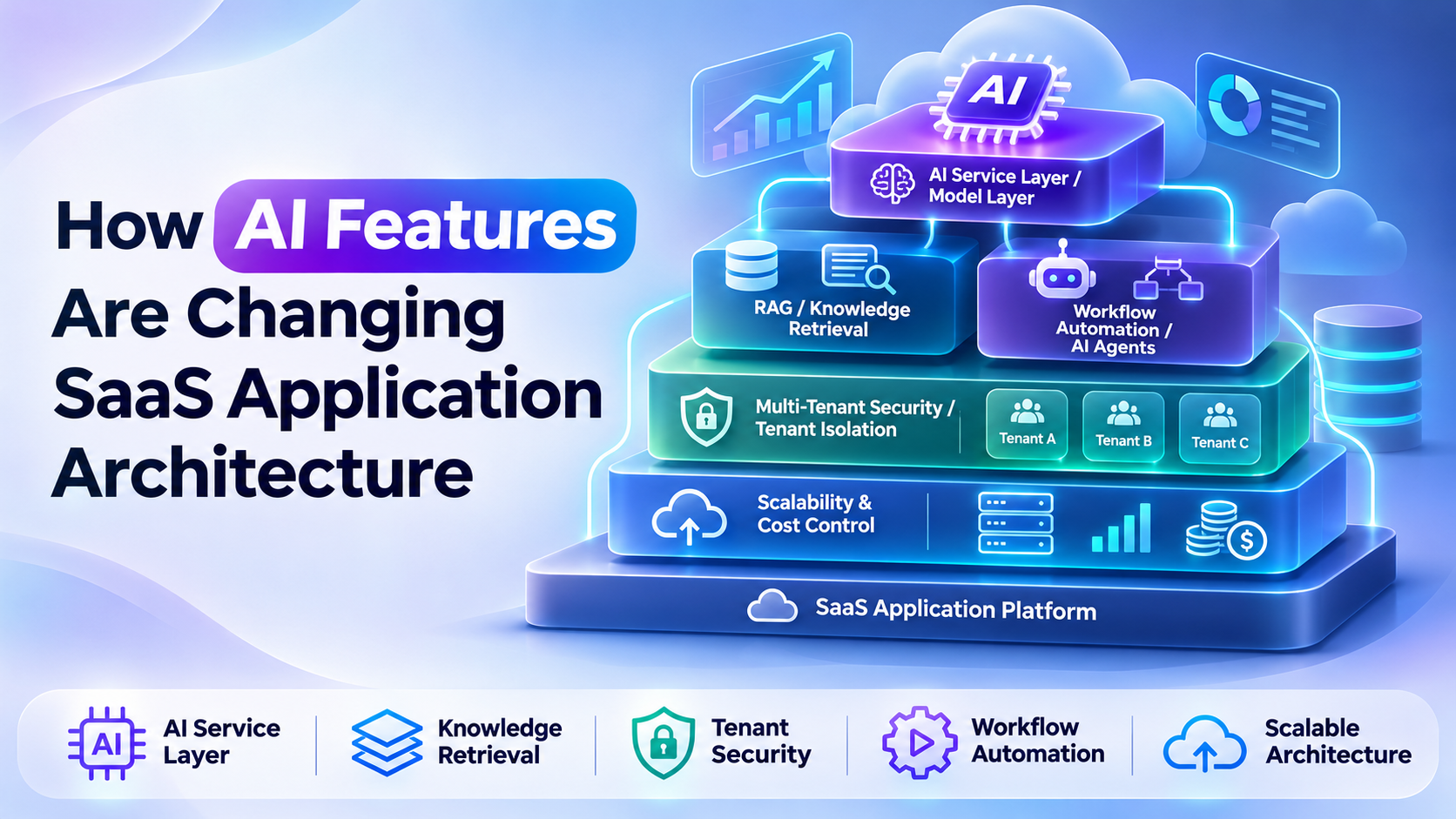
How AI Features Are Changing SaaS Application Architecture

A SaaS application that once handled user accounts, subscriptions, dashboards, and database operations may now be expected to summarize documents, answer customer questions, predict business outcomes, and automate decisions.
Adding these features sounds straightforward. Connect an AI API, build an interface, and the application becomes more intelligent.
But the technical reality is more complicated.
Traditional SaaS systems are designed around predictable business logic. A customer submits a request, the application processes defined rules, and the database returns a result.
AI-powered features introduce a different kind of workload. Responses may vary, processing times can fluctuate, external models may become unavailable, and the system may need to retrieve information from several sources before producing an answer.
These changes are forcing development teams to reconsider how SaaS applications are designed, secured, and maintained.
The challenge is no longer simply integrating AI. It is building an architecture that allows AI capabilities to operate reliably alongside existing business functions.
Why Traditional SaaS Architecture Needs to Evolve
Most SaaS applications rely on familiar components: frontend interfaces, backend APIs, databases, authentication services, and cloud infrastructure.
These systems are generally built around defined operations.
For example, when a customer requests an invoice, the application retrieves the relevant record and returns it.
An AI-powered financial assistant might perform a more complex task.
It could retrieve several invoices, examine payment histories, identify unusual transactions, and generate an explanation for the user.
Completing that request may involve database queries, retrieval services, language models, and additional validation.
A single user action can therefore trigger several interconnected processes.
This doesn't mean traditional SaaS architecture is obsolete. Its existing components remain essential.
However, AI introduces additional architectural responsibilities that must be managed without affecting the reliability of the core application.
1. AI Is Becoming a Separate Application Layer
One significant architectural change is the introduction of a dedicated AI service layer.
Instead of embedding language model requests directly into every application endpoint, developers can create a separate component responsible for AI operations.
This layer may handle model selection, prompt construction, response validation, usage tracking, and communication with external AI providers.
Consider a project management SaaS platform introducing three capabilities:
-
AI-generated project summaries
-
Automated task classification
-
Intelligent recommendations for project managers
Without a shared AI layer, each feature might independently connect to a model provider.
That approach can create duplicated logic and inconsistent security practices.
A centralized AI service allows developers to manage common responsibilities while keeping the existing application architecture organized.
It also makes future changes easier.
For example, a business may need to change its model provider or introduce a lower-cost model for simpler tasks. A dedicated integration layer can reduce the amount of application code affected.
However, centralization should not introduce unnecessary dependencies. The architecture must still support availability, appropriate access control, and independent scaling where required.
2. RAG Systems Are Changing How SaaS Applications Access Data
Traditional SaaS applications retrieve structured information through database queries and APIs.
AI features often need to work with unstructured information such as documents, knowledge bases, support conversations, and reports.
This is where retrieval-augmented generation (RAG) becomes relevant.
RAG allows an application to retrieve information from approved sources and provide it to a language model as context for generating an answer.
For example, a customer support SaaS platform might use RAG to answer questions based on product documentation and customer-specific support records.
A typical architecture may involve document ingestion, text processing, embeddings, search infrastructure, and a language model.
However, retrieval quality depends on more than storing embeddings.
Developers must consider document freshness, search relevance, metadata, permissions, and how retrieved information is evaluated.
Poor retrieval can produce inaccurate answers even when the underlying language model is capable.
AI-powered SaaS applications therefore need data architectures that support both conventional database operations and reliable knowledge retrieval.
3. Multi-Tenant Security Becomes More Complicated
Multi-tenancy is a defining characteristic of many SaaS platforms.
Multiple customers share application infrastructure while their data remains separated.
AI introduces new ways this separation can fail.
Consider a SaaS platform serving several accounting firms.
Each firm uploads financial documents and uses an AI assistant to retrieve information.
If the retrieval system does not enforce tenant permissions correctly, one firm's employee might receive information belonging to another organization.
Traditional database authorization alone may not protect every new AI component.
Security controls must extend to vector databases, document indexes, model context, caches, and external tools.
Microsoft's guidance on secure multitenant RAG systems emphasizes that retrieved information must be restricted to data the tenant or individual is authorized to access.
Development teams should therefore enforce tenant context throughout the AI processing pipeline.
For some applications, shared infrastructure with strict permission filtering may be appropriate. Others may require dedicated indexes, databases, or model deployments.
These decisions affect security, operating costs, and scalability.
4. AI Agents Are Introducing Workflow Orchestration
AI-powered SaaS applications are moving beyond generating answers.
Some systems allow AI agents to interact with tools, retrieve information, and coordinate multiple application operations.
For example, an AI assistant inside a CRM might analyze a customer request, retrieve account details, prepare a response, and create a follow-up task.
These activities involve several services and business rules.
Unlike a standard API operation, an AI-driven workflow may require multiple steps, changing context, and decisions about which tool to use next.
This increases the need for orchestration.
Developers must define which tools an agent can access, what actions it can perform, and when human approval is required.
For instance, an AI agent might be authorized to draft a customer refund recommendation but not issue the refund automatically.
Application-level permissions should enforce this restriction regardless of what the model generates.
The OWASP guidance on excessive agency identifies excessive functionality, permissions, and autonomy as important sources of risk.
As a result, AI agent architecture must combine flexible task execution with strict operational boundaries.
5. AI Workloads Are Changing SaaS Performance Requirements
Traditional SaaS performance is often measured through API response times, database latency, and application availability.
AI adds new performance considerations.
A database query may return a result quickly, while a complex AI request can require significantly more processing time.
Long documents, multiple model calls, and external API dependencies can increase latency.
This creates an architectural challenge when users expect immediate responses.
Developers may introduce streaming responses so users can begin reading generated content before the entire answer is complete.
For longer tasks, background processing may be more appropriate.
For example, a SaaS application generating a detailed financial analysis could create a background job rather than keeping an HTTP request open throughout the operation.
The user can continue working while the application processes the report.
Queue management, retries, timeouts, and failure recovery become increasingly important as these workloads grow.
Businesses must also consider what happens when an AI provider becomes unavailable.
A reliable application should prevent an external AI failure from unnecessarily disrupting essential SaaS functionality.
6. AI Inference Costs Are Becoming Part of SaaS Architecture
In traditional SaaS products, cloud hosting, storage, and database operations are major infrastructure expenses.
AI introduces another variable: inference costs.
Every model request can consume computing resources or generate API usage charges.
Costs may depend on the selected model, input length, generated output, and request volume.
For example, a SaaS platform serving 100 customers may initially have manageable AI expenses.
As adoption increases, thousands of users may begin requesting summaries, document analysis, or automated recommendations.
If every operation uses an expensive model unnecessarily, operating costs can rise.
Development teams can address these challenges through cost-aware architecture.
Common approaches include using smaller models for straightforward tasks, limiting unnecessary context, caching eligible repeated inputs, and tracking usage by feature or tenant.
Prompt caching and model selection are among the techniques documented in OpenAI's production guidance for improving efficiency.
However, optimization should not compromise the quality required for important business operations.
The goal is to match model capability and infrastructure spending to the complexity of each task.
7. Usage-Based Billing Needs More Detailed Tracking
AI is also influencing how SaaS businesses measure product consumption.
Traditional subscriptions often charge customers by user seats or feature tiers.
AI-powered functionality introduces measurable usage that may vary significantly between customers.
One organization might use an AI assistant occasionally, while another processes thousands of documents each month.
Charging both customers the same amount may create difficulties when their infrastructure consumption differs substantially.
This makes usage metering an important architectural consideration.
Development teams may need to record model requests, token consumption, processing jobs, and customer-level usage.
That information can support internal cost analysis, product limits, and customer billing where appropriate.
However, billing should reflect measurable value and remain understandable to customers.
An architecture that tracks usage accurately helps businesses experiment with subscription plans, credits, and consumption-based pricing without rebuilding their billing systems.
8. AI Applications Require Continuous Evaluation
Traditional software testing usually checks whether an application produces the expected result for a defined input.
Generative AI behaves differently.
A model may produce different answers to similar requests, and a response can be grammatically correct while containing inaccurate information.
This means AI-powered SaaS applications require additional evaluation methods.
For example, a support platform should not measure success only by whether its chatbot responds.
It should also evaluate whether answers are factually grounded, relevant, appropriately authorized, and useful to customers.
Development teams can create evaluation datasets containing realistic questions and expected outcomes.
They can then assess response quality when changing models, prompts, retrieval configurations, or application logic.
Production monitoring should also track operational metrics such as latency, failures, model usage, and escalation rates.
These practices help identify performance changes before they affect large numbers of customers.
AI reliability becomes an ongoing engineering responsibility rather than a final testing activity.
9. Data Governance Must Extend Beyond the Main Database
AI features often process more information than conventional SaaS functions.
Documents may be divided into chunks, transformed into embeddings, sent to external services, and included in model requests.
This creates additional data management responsibilities.
For example, when a customer deletes a confidential document, removing the original file may not automatically remove related embeddings, search indexes, or application caches.
Developers must consider the entire data lifecycle.
Important requirements include retention policies, secure deletion, access restrictions, provider data handling, and audit logging.
Different customers may also have different data residency or regulatory requirements.
For enterprise SaaS products, these considerations can influence whether AI services are shared across tenants or deployed through more isolated infrastructure.
Security and privacy are therefore architectural decisions, not simply settings added after development.
What Should SaaS Businesses Change Before Adding AI?
Not every SaaS product needs a completely new architecture to support AI.
A company introducing a basic text summarization feature may only need a well-designed API integration and suitable security controls.
A platform building document-aware assistants, autonomous workflows, and enterprise analytics may require additional infrastructure.
The appropriate design depends on the complexity of the use case.
Before implementation, businesses should evaluate whether the application can securely access the required data, manage AI request failures, monitor usage, and control operating costs.
Organizations considering SaaS application development services should also assess the development team's experience with AI integration, multi-tenant architecture, data pipelines, and cloud infrastructure.
Starting with a limited, measurable use case can help teams identify technical requirements before expanding AI capabilities across the product.
The objective should be to introduce useful intelligence without creating unnecessary operational complexity.
Final Thoughts
AI features are changing SaaS architecture by introducing new requirements for data retrieval, workflow orchestration, security, performance, and cost management.
Traditional application components remain essential, but development teams increasingly need to manage model services, tenant-aware retrieval, AI-specific monitoring, and more unpredictable workloads.
The most effective architectures separate responsibilities clearly while keeping core business functions dependable.
For organizations developing new SaaS products or adding AI capabilities to existing platforms, Spaculus Software offers SaaS application development services covering custom platforms, cloud architecture, integrations, and AI-powered functionality.
Ultimately, the next stage of SaaS development isn't simply about adding AI features. It is about building applications where AI capabilities remain secure, cost-effective, maintainable, and genuinely useful as the business grows.


