


Coastal Reliability on the Water: Navigating Marine Battery Chemistry, Cyclic Endurance, and Harsh Environments
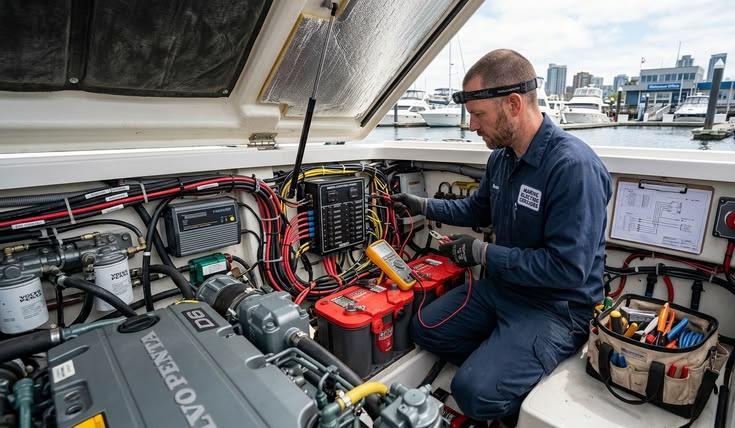
Boating and recreational water sports are deeply ingrained in New Zealand outdoor culture. From navigating the sheltered inlets of the Marlborough Sounds and Canterbury bays to crossing open ocean bars on deep-sea fishing expeditions, boaters place immense trust in their marine vessels. However, out on open water, mechanical and electrical reliability is not merely a matter of convenience; it is a fundamental safety imperative.
Unlike a motorcar on a motorway, a vessel on the ocean cannot pull over to the shoulder when an electrical failure occurs. An unexpected loss of battery power at sea leaves skippers without propulsion, marine VHF radio communications, GPS chartplotters, bilge pumps, or running lights. Understanding the engineering differences between marine energy storage systems and standard automotive batteries is the first step toward safeguarding coastal maritime safety.
A widespread mistake among novice boat owners is assuming that a standard automotive car battery can be installed in a marine vessel. While both battery types rely on twelve-volt lead-acid chemistry, automotive starting batteries are engineered for a benign operational environment that bears little resemblance to life on a watercraft.
A motorcar rides on a compliant suspension system over paved roads. In contrast, a boat hull is subjected to violent, repeated impacts as it cuts through coastal chop and ocean swell. In a standard automotive battery, these violent physical shocks cause the thin internal lead plates to flex, shed active lead oxide paste to the bottom of the casing, and eventually short-circuit against adjacent plates, resulting in sudden, catastrophic cell failure.
Furthermore, automotive batteries feature standard top-post terminals designed for friction-fit clamps. Marine environments require threaded stainless-steel marine posts or dual-terminal configurations. Threaded connections allow heavy-gauge marine wiring harnesses and auxiliary pump leads to be securely bolted down with locking nuts, preventing terminals from shaking loose in heavy seas.
The marine environment poses intense chemical challenges to electrical components. Salt spray and humid sea air create a highly conductive film of moisture across battery casings if surfaces are left uncleaned. This invisible salt bridge allows continuous parasitic electrical currents to creep between the positive and negative terminals, gradually discharging the battery even while the vessel is parked on a boat trailer.
Additionally, saltwater accelerates galvanic and atmospheric corrosion on copper wire strands, brass connectors, and battery terminals. Severe corrosion produces high electrical resistance, generating dangerous heat and causing severe voltage drop. When voltage drops, starter motors turn sluggishly, and sensitive marine electronics, such as sonar sounders and radar displays, shut down abruptly due to low-voltage protection circuits.
Investing in purpose-built marine batteries nz ensures boat owners receive units featuring heavy-duty polypropylene casings, reinforced plate anchoring, and epoxy-sealed internal components. These marine-grade units resist acid leakage during vessel heel or pitch and are engineered to withstand violent wave pounding without shedding internal plate material.
Marine power demands fall into two distinct operational profiles: engine starting and house auxiliary loads. Meeting these competing requirements effectively requires selecting the correct category of marine battery hardware.
Marine cranking batteries are engineered with high cold cranking and marine cranking amperage ratings. Their primary function is to spin high-compression inboard petrol engines or modern multi-valve outboard motors. They deliver intense starting currents within seconds, after which the outboard alternator rapidly replenishes the energy consumed during ignition.
Marine deep cycle batteries, by comparison, are built with thick, solid lead plates designed to deliver steady, sustained electrical current over many continuous hours. They power continuous onboard loads, including electric trolling motors, live-bait aerator pumps, automatic bilge pumps, navigation lighting, and cabin amenities. Deep cycle units tolerate being discharged down to fifty percent capacity hundreds of times without structural failure.
For smaller trailer boats and runabouts with limited physical space for two separate battery banks, marine dual-purpose batteries provide an effective compromise. Dual-purpose batteries feature plate thickness balanced between cranking ability and cyclic endurance, delivering enough surge amperage to start a moderate outboard engine while tolerating moderate cyclic loads from daytime marine electronics.
When selecting marine power storage, skippers must also evaluate internal battery chemistry. Traditional flooded lead-acid marine batteries remain popular due to their economical purchase price. However, they contain liquid acid electrolyte that can spill if the vessel experiences severe pitch, roll, or capsize. They also require periodic inspection to top up cell water levels and produce flammable hydrogen gas while charging, requiring well-ventilated battery lockers.
Absorbent Glass Mat (AGM) marine batteries have become the preferred choice for offshore and coastal mariners seeking absolute reliability. In an AGM battery, the liquid electrolyte is completely absorbed into micro-porous glass fibre mats sandwiched tightly between the plates. This construction makes AGM batteries completely spill-proof, leak-proof, and capable of operating safely at virtually any mounting angle.
AGM marine batteries also demonstrate significantly lower internal resistance. They accept charging current from outboard alternators or shore power chargers at a far higher rate, shortening recharge times between fishing trips. Their tightly compressed cell architecture provides the highest vibration resistance available in lead-based batteries, standing up to the harshest sea conditions with complete dependability.
Because many recreational boats are used seasonally, extended periods of winter storage are responsible for the vast majority of marine battery failures. Allowing a marine battery to sit on a trailer for months without charging leads to destructive plate sulphation, which permanently diminishes storage capacity and cranking amps.
Skippers should always disconnect the negative terminal or engage an onboard master isolation switch when storing a vessel to eliminate parasitic drains from digital clocks or automatic bilge pump float switches. Connecting a multi-stage smart marine battery maintainer keeps the battery fully charged at float voltage, preventing freezing and sulphation throughout the cold winter months.
For boat owners and commercial mariners who also manage road towing vehicles, securing dependable car battery installation nz ensures their towing truck or four-wheel drive has the starting power required to launch and retrieve vessels at slippery coastal boat ramps without hesitation.
Routine cleaning of battery posts with fresh water, drying thoroughly, and applying corrosion-inhibiting marine grease guarantees clean electrical contact and prolonged battery life. By matching marine battery chemistry to vessel power demands and respecting basic storage hygiene, boaters can head out to sea confident that their electrical systems will perform flawlessly from harbor departure to safe evening return.


 English
 Arabic
 Français
 Español
 Português
 Deutsch
 Türkçe
 Dutch
Dutch
 Italiano
 Russian
 Romaian
 Portuguese (Brazil)