

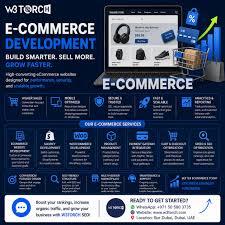
Ecommerce Website Development in Dubai: Build an Online Store for Modern Customers

The way customers discover and purchase products continues to evolve. Many shoppers prefer browsing online catalogues, checking product details, comparing prices, and placing orders from their phones or computers. Ecommerce Website Development in Dubai helps businesses create online stores that make these activities convenient while supporting the operational needs of the seller.
A successful ecommerce website combines an attractive storefront with reliable product management, secure payment processing, clear delivery information, and an uncomplicated checkout process. Each component contributes to the customer's experience, from the first product search to the arrival of an order.
Why Businesses Need an Ecommerce Website
An online store allows customers to explore products outside the opening hours of a physical shop. It can also help a business present a wider product range without relying entirely on in-person visits.
For companies selling to customers across different locations, ecommerce can provide a centralized platform for displaying prices, product availability, shipping details, and purchasing options.
An online store can also support better business planning by organizing order information and revealing which products receive attention. These insights can help retailers review inventory and improve product presentation.
Essential Elements of Ecommerce Website Development
Clear Product Pages
A product page should provide the information customers need to make a confident decision. Depending on the item, this may include photographs, specifications, materials, dimensions, available sizes, prices, and warranty information.
Descriptions should explain the product's practical benefits without making unsupported claims. High-quality images should show relevant details and provide a realistic representation of the item.
Convenient Navigation and Search
Customers should be able to locate products without navigating through an unnecessarily complicated menu. Categories, filters, and search functions can make larger catalogues easier to explore.
For example, a home furnishings store might allow customers to filter products by room, material, color, and price. A clothing retailer may need size, style, and availability filters.
Simple Checkout
A complicated checkout process can discourage customers from completing purchases. The buying journey should clearly show selected items, quantities, delivery costs, taxes where applicable, and the final payable amount.
Forms should request only necessary information, and customers should receive clear confirmation after an order is submitted.
Choosing the Right Ecommerce Platform
Ecommerce Website Development in Dubai may involve a hosted platform, a content management system with ecommerce functionality, or a custom-built application.
Hosted platforms can simplify store management and provide integrated commerce features. WooCommerce may suit businesses that prefer the flexibility of WordPress, while a custom application may be useful when a business has unusual pricing rules, advanced integrations, or specialized operational requirements.
The decision should consider product volume, customization needs, maintenance responsibilities, budget, and future expansion. A complex custom build is not always necessary for a small catalogue, while a basic template may not be sufficient for complicated workflows.
Payment Processing and Delivery Management
Customers should be able to understand which payment methods are available before completing an order. Businesses should select payment providers that suit their target market and comply with applicable requirements.
Delivery information should explain the service areas, estimated delivery periods, shipping charges, and procedures for returns or exchanges. If different products require different shipping arrangements, the website should communicate these differences clearly.
Order notifications can also improve the experience by confirming purchases and providing updates when orders are processed or dispatched.
Mobile-Friendly Store Design
Mobile usability is essential because customers may discover products through social media, search engines, or links shared by friends. Product images, menus, forms, and checkout buttons should work well on smaller screens.
Developers should test the full shopping journey on several devices. Checking only the homepage is insufficient because problems may appear on product pages, payment screens, or account forms.
Image compression, suitable hosting, and efficient code can help improve loading performance.
Security and Customer Privacy
Online stores handle customer details and transaction-related information, so security must be considered throughout development.
Useful measures include HTTPS, secure administrator access, reliable backups, software updates, and reputable payment integrations. Businesses should limit access to customer information and publish clear privacy and return policies.
Payment details should be handled through appropriately secured systems rather than stored unnecessarily.
How to Improve Online Store Performance
Product descriptions should answer real customer questions and use consistent terminology. Descriptive page titles, useful category text, and internal links can help visitors discover related products.
Analytics can help businesses understand where shoppers leave the purchasing process. If customers frequently abandon the cart, the business can investigate shipping costs, form complexity, payment availability, or unclear delivery information.
Changes should be based on evidence and tested carefully.
Conclusion
Ecommerce Website Development in Dubai gives businesses a platform for presenting products, processing orders, and serving customers online. A strong store combines useful product information, easy navigation, secure payments, reliable delivery details, and mobile-friendly design.
By choosing a suitable platform and regularly reviewing the shopping experience, businesses can build an online store that supports customers and adapts to changing commercial needs.


